
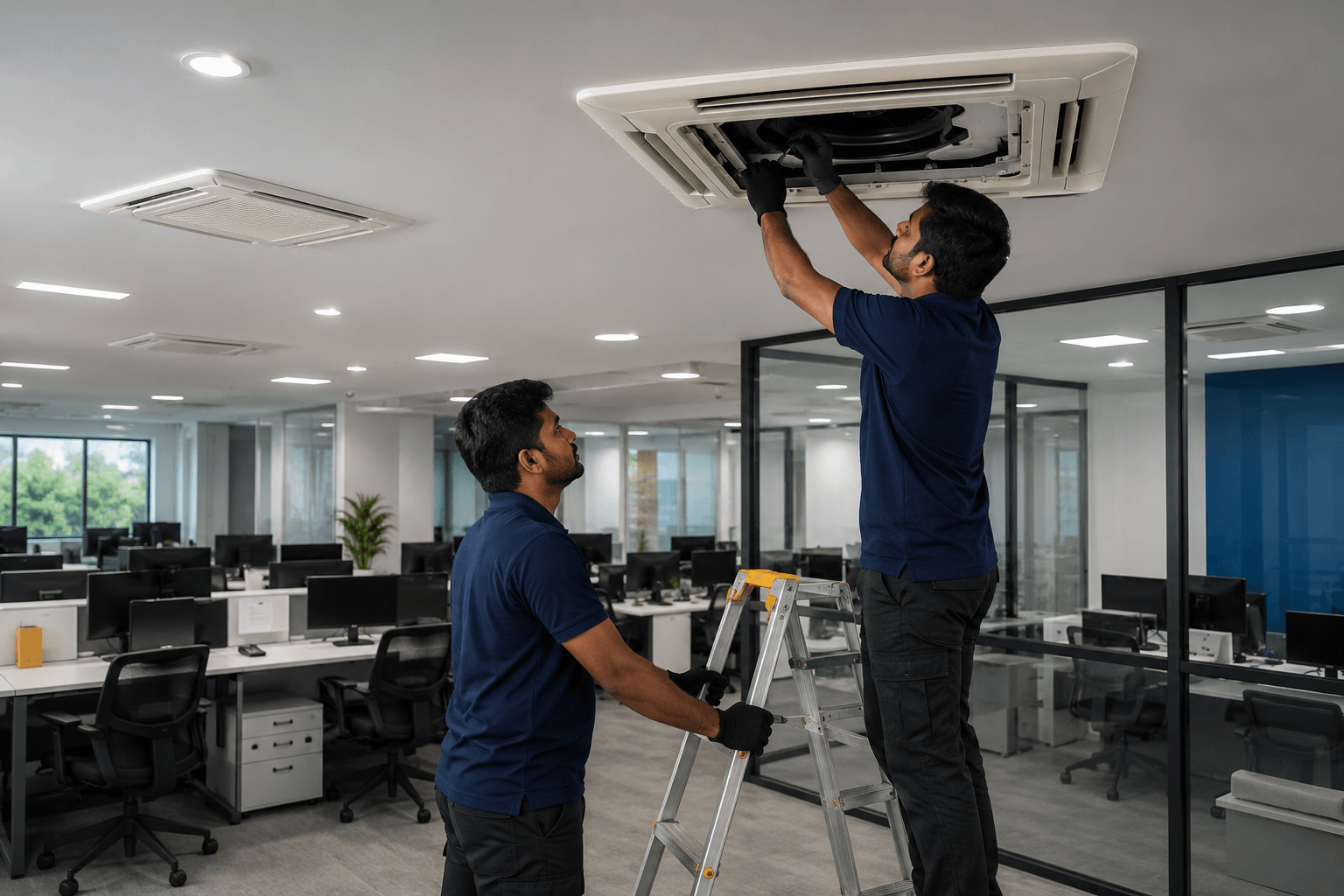
Spend one sweaty afternoon in a Chennai office where the AC is barely doing its job and you will get it immediately. People start losing focus around the two-hour mark. Someone’s fanning themselves with a folder. Another person keeps checking the thermostat as if staring at it harder will fix something. A bad air conditioner does not just make people uncomfortable, it quietly kills the whole workday. So which AC is best for office use in 2026? There is no clean universal answer here. It really comes down to your office size, how many people are in the room, what equipment is running and honestly how many hours a day that system is going to be switched on.
At Techno Power Aircons we have been at this since 1982, setting up cooling systems for offices and commercial spaces all across Chennai and Tamil Nadu. We have seen the mistakes people repeat and we have seen the setups that actually hold up five or ten years later. This is a straightforward guide to help you make the right call before you spend the money.
Why Office Cooling Is a Completely Different Problem
Most people approach an office AC the same way they would buy one for their bedroom. That is where things start going wrong.
A home AC runs maybe five or six hours a day. An office unit is running ten, sometimes twelve hours without stopping. The heat load inside is also heavier because you have got multiple computers going, fluorescent or LED lighting, maybe a server tucked in the corner and several people sitting close together all adding to the warmth. That decent 1.5-ton split AC that keeps your bedroom perfectly cool at night will genuinely struggle in a 300 sq ft open office with six workstations.
Offices have specific needs that residential buyers never really think about:
- Uniform cooling so the person sitting near the window is not sweating while the one next to the unit is freezing
- Low noise because nobody should have to talk louder on a client call because the AC is rattling overhead
- Enough efficiency to keep the electricity bill from becoming a monthly shock
- Maintenance that does not mean shutting the whole office down for a few hours
Get any one of those wrong and you are going to hear about it. Regularly.
AC Types and Where Each One Actually Fits
Split AC – Cabins and Small Rooms
For individual cabins or small offices under 200 sq ft, a standard inverter split AC from Daikin, Blue Star, Mitsubishi Electric or Voltas does the job well. Easy to install, not complicated to maintain and quiet enough for most close-quarters work.
The limitation appears the moment you try to use it in an open layout. A split AC pushes air in one direction. In a wider room one half of the floor gets cooled properly while the other half gets whatever is left after the air travels across. Multiple units can compensate but then you end up with competing airflows and cold and warm pockets around the room.
Talking to a reliable AC dealer in Chennai before you buy will at least make sure the tonnage is right for the room. That calculation goes wrong more often than people expect.
Cassette AC – The Practical Choice for Open Offices
Cassette units go into the false ceiling and push air out from all four sides at once. So every corner of the room gets coverage, not just the area directly below the unit. For open offices somewhere between 300 and 800 sq ft this is almost always the best AC for office settings, there is not much debate about it.
They also run quieter than wall-mounted splits because the whole fan assembly is inside the ceiling void rather than sitting out on a bracket on your wall. If you have ever tried to talk through a video call while a split AC cycles up loudly two feet from your head, you will know exactly why that matters. Cassette units go up to 5 tons capacity so in many cases a single unit handles the whole floor.
If your office has a false ceiling, start here.
Ductable AC – When You Want Nothing Visible at All
Ductable systems sit above the ceiling and push cooled air through ductwork to wherever you need it distributed. From inside the office you see nothing except slim grilles in the ceiling. No boxes on the wall, no pipes running across the room. For large conference rooms, wide open floors above 1,000 sq ft or reception areas where the look of the space actually matters, this is the cleaner option.
The trade-off is that ductwork needs ceiling clearance and it is far easier to plan for during an initial fit-out than to try and squeeze in later. If you are building a new office or doing a serious renovation right now, this is the time to sort it. Experienced HVAC contractors in Chennai will say the same.
VRF/VRV System – For Multi-Zone Offices and Larger Buildings
A VRF system uses one outdoor unit connected to multiple indoor units spread across different rooms and floors. Each zone runs its own temperature setting independently. The server room sits at 20°C, the main floor at 24°C, the conference room at 22°C, all controlled separately, all from one outdoor unit. In a real office that kind of zone control makes a genuine difference.
The bigger advantage is efficiency. An empty meeting room does not need to pull the same cooling load as a packed open floor at two in the afternoon. VRF systems adjust refrigerant flow in real time based on what each zone actually needs. Over a full year of long operating hours that adjustment adds up to real savings on the electricity bill.
For any office project above 2,000 sq ft or buildings with departments that have different schedules and cooling needs, look at VRF/VRV AHU Air Conditioners before committing to anything else.
Things Worth Checking Before You Decide
Heat load before brand.
Office heat loads are consistently higher than residential because of equipment and headcount. A rough number is 1 ton for every 100 to 150 sq ft but that is just a starting point. A proper calculation takes your layout, sun exposure, floor level and what is actually running inside into account. Getting it wrong costs you efficiency and comfort for however long the system runs.
Star rating matters more here than at home.
A 5-star inverter unit running eight hours a day saves 30 to 40 percent compared to a 3-star model. Across a full year and multiple units that is not a trivial gap. When comparing the best AC brands in Chennai look at the ISEER number on the label, not just the sticker price.
Noise adds up.
Cassette ACs and VRF indoor units run at around 28 to 38 decibels, which most people barely register. Certain wall-mounted splits under load push 45 decibels or more. The difference is not subtle when you are sitting underneath it during a call.
Plan for service before something breaks.
An AC AMC in Chennai keeps the system on a maintenance schedule so small issues get caught before they become expensive ones. In peak summer, waiting for an emergency technician is not a position you want to be in.
Brands That Hold Up Well in Office Settings
Daikin gets specified first in most commercial projects and the reason is not just reputation. Energy efficiency, noise levels and service availability all hold up consistently. A lot of VRF/VRV AC dealers in Chennai default to Daikin for multi-zone office work and it is generally the right call.
Mitsubishi Electric is for offices where noise cannot be a factor. Client-facing rooms, recording spaces, premium boardrooms. The price is higher but the decibel levels justify it.
Blue Star is built around Indian commercial conditions and it shows. Long operating hours, humidity and voltage inconsistency are all things the brand accounts for. Blue Star AC dealers in Chennai have one of the denser service networks in the city which matters when something needs attention quickly.
O General is the reliable choice when the outdoor unit is going to sit on a rooftop under the full Chennai afternoon sun. Built for high ambient conditions and generally dependable over years of use.
Voltas is the sensible mid-range option. Solid 5-star models, reasonable price and good enough service coverage when the budget is a real consideration.
Quick Office AC Selection Reference
| Office Type | Recommended AC | Tonnage Range |
| Private cabin (up to 150 sq ft) | Inverter Split AC | 1 to 1.5 Ton |
| Small open office (150 to 300 sq ft) | Split or Cassette AC | 1.5 to 2 Ton |
| Mid-size open floor (300 to 800 sq ft) | Cassette AC | 2 to 5 Ton |
| Large hall or conference room (800 sq ft+) | Ductable or VRF | 3 Ton and above |
| Multi-room or multi-floor building | VRF/VRV System | Varies by zone |
Get the Assessment Done Before You Buy Anything
The single most expensive habit in office AC buying is purchasing the unit first and figuring out installation later. For any space above 300 sq ft, a site assessment genuinely changes what you end up buying. Occupant count, window size, which walls face the sun, ceiling height, equipment load – every one of those factors moves the number.
HVAC consultants in Chennai run through all of that before recommending anything. It takes one site visit and it prevents the much worse situation of watching an undersized unit churn away nonstop in June and still not reach the temperature on the thermostat.
Getting this right from the start also makes the broader HVAC engineering services side of things smoother – duct routing, drainage, electrical load and outdoor unit placement all need to be sorted before the installation team shows up, not on the day.
Spare Parts and Keeping It Running
Once the warranty is done the thing that protects your investment is access to genuine parts and trained people who show up in reasonable time. Daikin, Blue Star, Mitsubishi Electric and O General all have solid AC spare parts dealers in Chennai and established technician networks across the city.
A maintenance contract covering filter cleaning, refrigerant levels, drain clearing and electrical checks means the system stays at consistent efficiency through the year rather than getting looked at only after something stops working.
So What Is the Answer?
Cassette AC or VRF system for most mid-to-large office environments. 5-star inverter split for cabins and small rooms. That is the short version. The longer version is that the best AC for office use in 2026 is whichever system you have sized correctly for your actual heat load, installed by people who know what they are doing and kept on a proper maintenance schedule.
A well-known brand bolted into the wrong configuration will still underperform. Get the type right first. Then choose the brand.
Get Proper Advice From People Who Know Chennai Offices
Techno Power Aircons has been handling office and commercial AC installations across Chennai since 1982. We work with split ACs, cassette ACs, ductable systems and VRF/VRV systems from Daikin, Blue Star, Mitsubishi Electric, O General, Voltas, Hitachi and Panasonic.
Heat load calculation, system design, installation, commissioning and AMC support – we handle all of it. We are not pushing one brand over another. We will tell you what actually suits your space.
Call us today for a free consultation.
Frequently Asked Questions
Q1. Which AC is best for office use in India in 2026?
Cassette ACs for open-plan floors. Split ACs for cabins and enclosed rooms. VRF systems for multi-zone or multi-floor buildings. The type matters more than the brand name on the box.
Q2. How much tonnage does an office space need?
A rough starting point is 1 ton per 100 to 150 sq ft. But offices run hotter than homes because of equipment and people, so get a proper heat load calculation done for any space above 300 sq ft.
Q3. Is VRF worth the cost for a medium-sized office?
Yes, if the office has different zones with different cooling needs or runs eight or more hours daily. The energy savings over three to five years generally justify the higher upfront cost.
Q4. Which brand is best for a Chennai office?
Daikin for VRF and cassette setups. Blue Star for after-sales reliability. Mitsubishi Electric when noise is non-negotiable. O General for high outdoor temperatures.
Q5. How often should an office AC be serviced?
Filter cleaning every two to three months. Full service every six months. An AC AMC in Chennai puts this on a schedule so nothing slips through.
Leave a Reply