
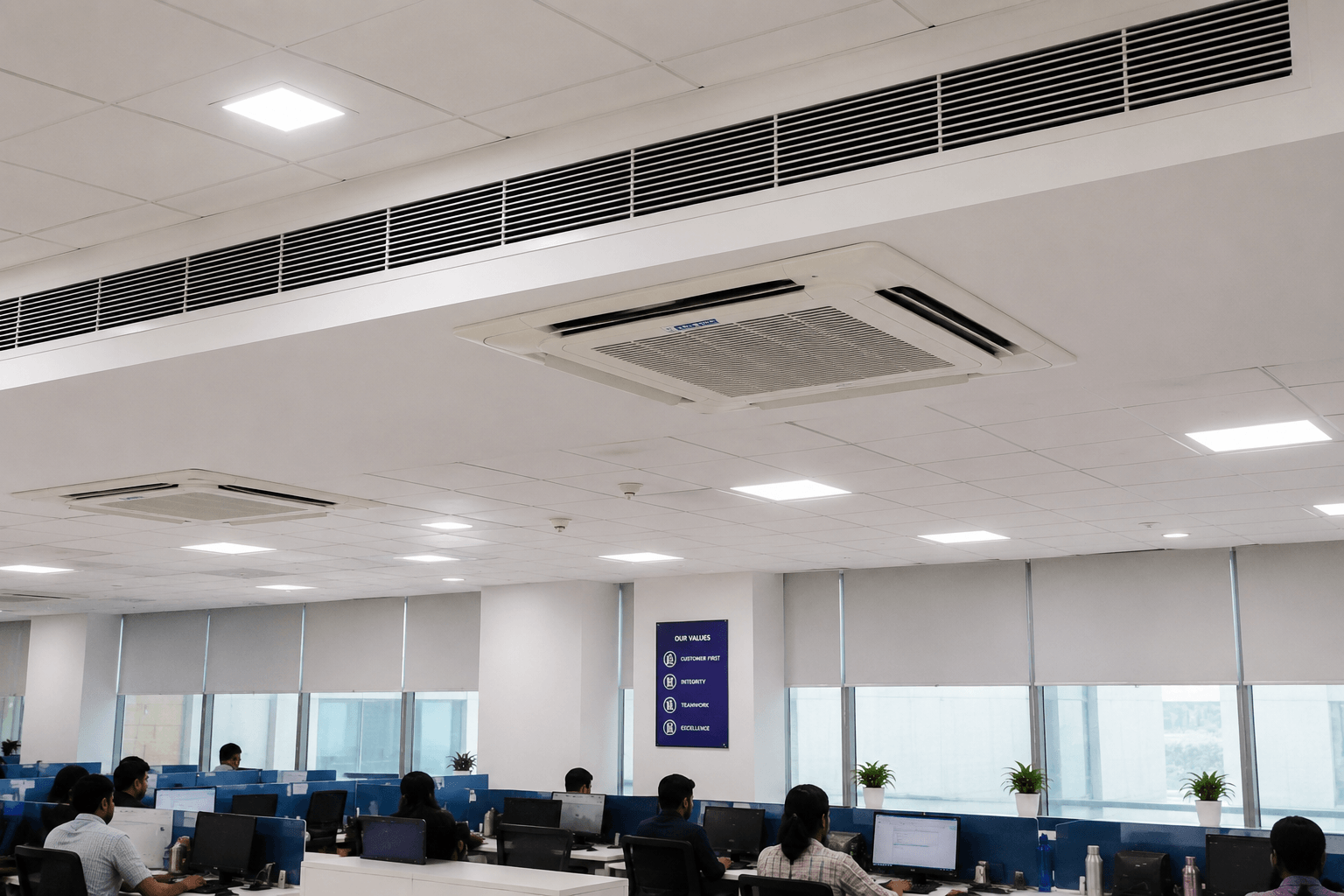
Planning to install a VRF AC system in an office, showroom, hotel, commercial building or premium residence in Chennai? Understanding the installation process, technical requirements and cost factors is essential before selecting equipment or finalising a quotation.
Unlike a conventional split AC installation, a VRF air-conditioning project may involve multiple indoor units, outdoor unit configurations, refrigerant piping networks, communication wiring, individual controllers and specialised commissioning procedures.
The installation requirements can vary significantly depending on the building layout, cooling capacity, number of rooms, available ceiling space, outdoor unit location and electrical infrastructure.
For example, installing a VRF system in a small corporate office is different from setting up a multi-floor VRF air-conditioning system for a commercial building or hotel.
This guide explains VRF AC installation in Chennai, including the step-by-step installation process, important technical requirements, factors affecting installation costs and how to plan a commercial VRF project.
What Is a VRF AC System?
VRF stands for Variable Refrigerant Flow. It is an air-conditioning technology that adjusts refrigerant flow according to the cooling requirements of connected indoor units.
A typical VRF system consists of one or more outdoor units connected to multiple compatible indoor units through refrigerant piping and communication wiring.
Depending on the system configuration, different rooms or zones can be controlled independently, making VRF technology suitable for buildings with varying cooling requirements.
VRF systems are commonly considered for:
- Corporate offices and IT workplaces
- Multi-floor commercial buildings
- Retail showrooms and shopping spaces
- Hotels and serviced apartments
- Restaurants and selected hospitality properties
- Clinics and suitable healthcare spaces
- Premium villas and large residences
- Mixed-use commercial properties
Businesses evaluating a VRF AC system in Chennai should consider the building’s cooling requirements, number of zones, operating hours and installation conditions before selecting equipment.
VRF vs VRV: What Is the Difference?
VRF stands for Variable Refrigerant Flow, while VRV stands for Variable Refrigerant Volume.
VRV is Daikin’s trademarked terminology for its variable-refrigerant system technology.
Both terms are commonly associated with multi-zone refrigerant-based air-conditioning systems. However, available features, system configurations and installation requirements vary by manufacturer and model.
VRF AC Installation Process in Chennai
VRF installation involves several stages, beginning with building assessment and equipment selection, followed by piping, electrical work, testing and commissioning.
The installation process should follow the selected manufacturer’s technical requirements and applicable safety standards.
1. Site Inspection and Building Assessment
The first step is understanding the building’s layout, usage and available infrastructure.
Important site assessment factors include:
- Total floor area and number of floors
- Number of rooms and cooling zones
- Expected occupancy
- Daily operating hours
- Ceiling height and false ceiling availability
- Window area and solar heat gain
- Electrical supply arrangements
- Outdoor unit installation locations
- Refrigerant piping routes
- Condensate drainage arrangements
- Access for installation and future maintenance
A proper site assessment helps identify potential installation challenges before equipment is ordered.
2. Cooling Load Assessment
VRF system capacity should be selected according to the building’s actual cooling load rather than floor area alone.
Commercial cooling requirements depend on several factors:
- Floor area and ceiling height
- Occupancy levels
- Lighting and electrical equipment
- Glass area and solar heat gain
- Building insulation
- Outdoor-air and ventilation requirements
- Operating schedules
For example, a glass-fronted showroom may require a different cooling capacity from an enclosed office of similar size.
Oversized systems may increase initial investment and affect operating efficiency. Undersized systems may struggle to maintain the required indoor temperature during peak conditions.
An appropriate cooling-load assessment is therefore important before finalising VRF equipment capacity.
3. VRF System Selection and Configuration
Once the cooling requirements are established, the next step is selecting a suitable VRF system configuration.
Important equipment decisions include:
- Outdoor unit capacity and configuration
- Number of indoor units
- Indoor unit type and capacity
- Refrigerant piping arrangement
- Individual temperature controllers
- Central control options where required
- Electrical and communication requirements
Different VRF brands may offer cassette, ducted, wall-mounted, ceiling-suspended and floor-standing indoor unit options.
All selected indoor and outdoor units must be compatible with the proposed system configuration.
4. Outdoor Unit Installation
VRF outdoor units require suitable placement to support heat rejection, safe operation and future maintenance access.
Common installation locations include terraces, designated outdoor equipment areas and suitable service platforms.
Important considerations include:
- Manufacturer-required airflow clearances
- Structural support and equipment weight
- Stable mounting arrangements
- Vibration control where required
- Safe lifting and handling
- Electrical access
- Weather exposure
- Maintenance accessibility
Outdoor units should not be installed in locations where restricted airflow could affect cooling performance.
5. Indoor Unit Installation
VRF indoor units are selected according to room size, cooling requirements, airflow distribution and interior design.
Different indoor unit types have different installation requirements.
| Indoor Unit Type | Typical Application | Installation Considerations |
|---|---|---|
| Cassette indoor unit | Offices, meeting rooms and retail spaces | False ceiling space, mounting and drainage |
| Ducted indoor unit | Showrooms and larger commercial areas | Ductwork, insulation and airflow |
| Wall-mounted indoor unit | Cabins and individual rooms | Wall space, piping and drainage |
| Ceiling-suspended indoor unit | Selected commercial interiors | Mounting supports and airflow clearance |
| Floor-standing indoor unit | Selected rooms and commercial areas | Floor space and piping routes |
For commercial interiors, cassette air conditioners and compatible ducted VRF indoor units are commonly considered where suitable ceiling arrangements are available.
6. Refrigerant Copper Piping Installation
Refrigerant piping connects the outdoor VRF system to the indoor units.
VRF installations may require multiple pipe branches, refrigerant distribution components and longer piping routes than conventional single-room AC installations.
Important piping requirements include:
- Manufacturer-approved copper pipe specifications
- Correct pipe diameter
- Permitted refrigerant piping lengths
- Maximum allowable height differences
- Approved branch joint arrangements
- Proper pipe supports
- Suitable thermal insulation
- Protection against contamination and moisture
Incorrect pipe sizing, unsuitable routing or improper branch connections can affect system performance and reliability.
Refrigerant piping must be installed according to the manufacturer’s instructions.
7. Condensate Drainage Installation
Indoor VRF units generate condensate during cooling operation. This water must be removed through suitable drainage arrangements.
Drainage installation may involve:
- Condensate drain piping
- Appropriate drainage slope
- Drain pumps where fitted
- Suitable pipe insulation
- Safe discharge arrangements
- Drainage testing
Improper drainage can cause water leakage, ceiling damage and operational problems.
8. Electrical and Communication Wiring
VRF systems require electrical power connections and communication wiring between relevant system components.
Depending on the system, electrical installation may include:
- Suitable power supply arrangements
- Correct cable sizing
- Electrical protection devices
- Isolators and earthing
- Indoor and outdoor unit communication wiring
- Individual controllers
- Central control systems where applicable
Electrical installation should be performed by qualified personnel in accordance with equipment specifications and applicable safety requirements.
9. Refrigerant System Testing
Before commissioning, the installed refrigerant piping must be checked according to manufacturer-approved procedures.
Testing activities may include:
- Refrigerant circuit inspection
- Pressure testing
- Leak checking
- System evacuation
- Moisture removal
- Refrigerant charge verification
Testing pressures, procedures and refrigerant handling requirements depend on the equipment and refrigerant type.
These activities should be carried out by appropriately trained technicians using suitable equipment.
10. VRF System Commissioning
Commissioning is the final technical stage before the VRF system is handed over for normal operation.
Depending on the equipment, commissioning may involve:
- Electrical safety checks
- Indoor and outdoor unit communication verification
- Controller configuration
- System addressing where applicable
- Refrigerant charge verification
- Drainage testing
- Operating parameter checks
- Cooling performance verification
- Fault code review
- Documentation and handover
Manufacturer-specific commissioning procedures should be followed to support correct operation.
Technical Requirements for VRF AC Installation
VRF installation requires suitable equipment, infrastructure and building conditions.
| Technical Requirement | What to Check |
|---|---|
| Cooling capacity | Building heat load and individual zone requirements |
| Indoor unit selection | Room layout, airflow and equipment compatibility |
| Outdoor unit placement | Airflow, structural support and service access |
| Refrigerant piping | Pipe specifications, routing and manufacturer limits |
| Electrical infrastructure | Power supply, cable sizing and protection |
| Communication wiring | Compatible control connections |
| Drainage | Condensate removal and discharge routing |
| Ceiling space | Indoor unit clearance and maintenance access |
| Controls | Individual or central temperature management |
| Commissioning | Testing, configuration and performance verification |
Existing commercial buildings may require additional assessment to determine whether their infrastructure can support the proposed VRF installation.
VRF AC Installation Cost in Chennai
VRF AC installation cost in Chennai depends on the complete project scope, including equipment configuration, installation materials, building conditions and commissioning requirements.
A reliable quotation cannot be determined using floor area or the number of rooms alone.
Two buildings with similar floor areas may have different installation costs because of piping routes, cooling loads, ceiling arrangements and electrical requirements.
Main Factors Affecting VRF AC Installation Cost
| Cost Factor | How It Affects Installation Cost |
|---|---|
| Cooling capacity | Determines equipment size and configuration |
| Number of indoor units | Affects equipment, piping, wiring and labour |
| Indoor unit type | Influences mounting, ductwork and drainage requirements |
| Outdoor unit configuration | Affects placement, supports and electrical arrangements |
| Copper piping length | Influences material quantities and labour |
| Branch connections | Adds refrigerant distribution components |
| Electrical infrastructure | May require cables, protection devices or modifications |
| Controllers | Individual and central control options affect cost |
| Building access | May require lifting equipment or additional safety measures |
| Commissioning | Includes testing and system verification procedures |
Important: These are cost factors rather than fixed installation prices. Actual quotations should be based on project-specific requirements.
For more information, read our VRF AC System Price in Chennai guide.
VRF AC Equipment Cost vs Installation Cost
When reviewing a VRF quotation, it is important to distinguish between equipment costs and installation-related expenses.
| Quotation Component | What to Verify |
|---|---|
| Outdoor units | Brand, model, capacity and quantity |
| Indoor units | Type, capacity and quantity |
| Copper piping | Specifications and measured lengths |
| Branch joints | Compatible refrigerant distribution components |
| Insulation | Material specifications and thickness |
| Drainage | Condensate pipework and discharge arrangements |
| Electrical work | Cables, isolators and protection devices |
| Controls | Individual controllers and central control options |
| Installation labour | Equipment mounting, piping and connections |
| Testing | Pressure testing, evacuation and system checks |
| Commissioning | Configuration and performance verification |
| Taxes | Applicable GST and other charges |
Some quotations may exclude electrical modifications, false ceiling work, structural supports or additional piping.
Always compare the complete scope of work rather than equipment price alone.
VRF AC Installation for Different Building Types
VRF systems can be considered for different commercial and residential properties, but installation requirements vary according to building use.
| Building Type | Typical Requirement | Installation Considerations |
|---|---|---|
| Corporate office | Multiple cooling zones | Room-wise control and operating schedules |
| Retail showroom | Cooling for customer and display areas | Air distribution and solar heat gain |
| Multi-floor commercial building | Indoor units across several floors | Piping lengths, height differences and controls |
| Hotel | Room-wise temperature control | Equipment configuration and operating patterns |
| Clinic | Cooling for suitable individual areas | Room usage and ventilation requirements |
| Premium villa | Multi-room comfort cooling | Indoor unit aesthetics, noise and placement |
Specialised healthcare or hospitality spaces may require additional ventilation, filtration or humidity-control provisions beyond comfort cooling.
How Long Does VRF AC Installation Take?
The installation timeline depends on project size, number of indoor units, piping complexity, building readiness and commissioning requirements.
A small office project with a limited number of indoor units is different from a multi-floor commercial installation requiring extensive refrigerant piping and coordinated interior work.
Factors affecting installation time include:
- Equipment availability
- Number and type of indoor units
- Outdoor unit location
- Refrigerant piping length
- False ceiling and interior work readiness
- Electrical infrastructure
- Building access
- Testing and commissioning requirements
Businesses should request a project-specific installation schedule before work begins.
Common VRF AC Installation Mistakes to Avoid
1. Selecting Equipment Based Only on Floor Area
Floor area alone does not account for occupancy, solar heat gain, equipment loads and ventilation requirements.
2. Ignoring Refrigerant Piping Limitations
Pipe lengths, height differences and branch arrangements must remain within manufacturer-approved limits.
3. Poor Outdoor Unit Placement
Restricted airflow and inadequate maintenance access can affect system performance and serviceability.
4. Inadequate Drainage Planning
Incorrect drainage arrangements can cause water leakage and damage to ceilings or interiors.
5. Insufficient Maintenance Access
Indoor and outdoor units should remain accessible for future inspection and servicing.
6. Incomplete Testing and Commissioning
Skipping required tests can leave installation defects undetected.
7. Comparing Quotations Without Reviewing Inclusions
A lower quotation may exclude important installation materials, electrical work or commissioning activities.
VRF AC Maintenance After Installation
Regular maintenance helps protect VRF system performance and reduce avoidable breakdowns.
Maintenance activities may include:
- Cleaning indoor unit filters
- Inspecting indoor and outdoor coils
- Checking drainage arrangements
- Inspecting electrical connections
- Reviewing controller operation
- Checking refrigerant system condition
- Reviewing fault codes and operating alerts
- Verifying cooling performance
Maintenance procedures and service intervals should follow manufacturer guidance and actual operating conditions.
Businesses can explore AC AMC services in Chennai when planning ongoing maintenance support.
How to Get an Accurate VRF AC Installation Quotation in Chennai
Before requesting a quotation, prepare the following information:
- Property location in Chennai
- Building type and intended use
- Approximate floor area
- Number of floors
- Number of rooms or cooling zones
- Expected occupancy
- Daily operating hours
- Existing or planned false ceiling
- Preferred indoor unit types
- Possible outdoor unit location
- Existing electrical infrastructure
- Expected installation timeline
Providing these details helps an AC solutions provider understand the proposed project and identify further assessment requirements.
Ask for an itemised quotation covering equipment, piping, insulation, wiring, installation labour, testing, commissioning, taxes and exclusions.
VRF AC Solutions from Techno Power Aircons
Techno Power Aircons is a Chennai-based air-conditioning solutions provider offering multi-brand AC systems, including VRF/VRV, cassette and ductable air conditioners.
The company’s website presents installation, maintenance, AMC and after-sales support as part of its air-conditioning solutions.
Businesses and property owners planning VRF air-conditioning projects can contact Techno Power Aircons to discuss system options, installation requirements and project-specific quotations.
Request a VRF AC Installation Quote in Chennai
Planning VRF air conditioning for an office, showroom, commercial building or premium residence?
Contact Techno Power Aircons to discuss your cooling requirements and request a detailed VRF AC installation quotation.
Website: https://www.technoaircons.in/
Phone: +91 95660 98001
For a more useful initial enquiry, share your property type, location, approximate floor area, number of rooms and expected installation timeline.
Frequently Asked Questions
1. What is the VRF AC installation cost in Chennai?
VRF AC installation cost in Chennai depends on cooling capacity, number of indoor units, piping length, building layout, electrical requirements and commissioning scope. A site-specific quotation is the most reliable way to determine the final cost.
2. What are the main requirements for VRF AC installation?
Important requirements include appropriate cooling capacity, compatible indoor and outdoor units, manufacturer-approved refrigerant piping, suitable electrical infrastructure, drainage, controls, structural support and maintenance access.
3. How long does VRF AC installation take?
Installation time varies according to project size, equipment configuration, piping complexity, building readiness and commissioning requirements.
4. Can VRF AC be installed in an existing building?
Yes, VRF AC can be installed in many existing buildings, subject to available piping routes, ceiling space, electrical infrastructure, outdoor unit placement and technical feasibility.
5. Is VRF AC suitable for office buildings?
Yes. VRF systems are commonly considered for offices with multiple rooms, cabins and meeting areas requiring different temperature settings or operating schedules.
6. What indoor units can be used with VRF AC?
Depending on the manufacturer and system configuration, compatible indoor units may include cassette, ducted, wall-mounted, floor-standing and ceiling-suspended models.
7. Does VRF AC installation require a false ceiling?
Not always. Ceiling-concealed cassette and ducted indoor units generally require suitable ceiling space, while compatible wall-mounted or floor-standing units may not require a false ceiling.
8. Does VRF installation include copper piping?
Copper piping may be included within a specified quotation scope or charged separately. The proposal should clearly state pipe specifications, measured lengths, insulation and additional charges.
9. Is testing and commissioning necessary for VRF AC?
Yes. Manufacturer-required testing and commissioning are important for verifying refrigerant system integrity, electrical connections, controls and overall equipment operation.
10. How can I get a VRF AC installation quotation in Chennai?
Share your building details, cooling requirements, property location and project timeline with a VRF AC provider. Request an itemised quotation covering equipment, installation materials, labour, testing, commissioning and taxes.
Conclusion
VRF AC installation in Chennai requires careful planning, appropriate equipment selection and installation procedures that follow manufacturer specifications.
The total project cost depends on cooling capacity, indoor and outdoor unit configuration, refrigerant piping, electrical infrastructure, controls, building access and commissioning requirements.
For offices, commercial buildings, hotels, showrooms and premium residences, a properly selected and installed VRF system can provide flexible multi-zone cooling.
Planning a VRF AC installation project in Chennai? Contact Techno Power Aircons to discuss suitable VRF/VRV air-conditioning solutions and request a detailed project quotation.
Leave a Reply