
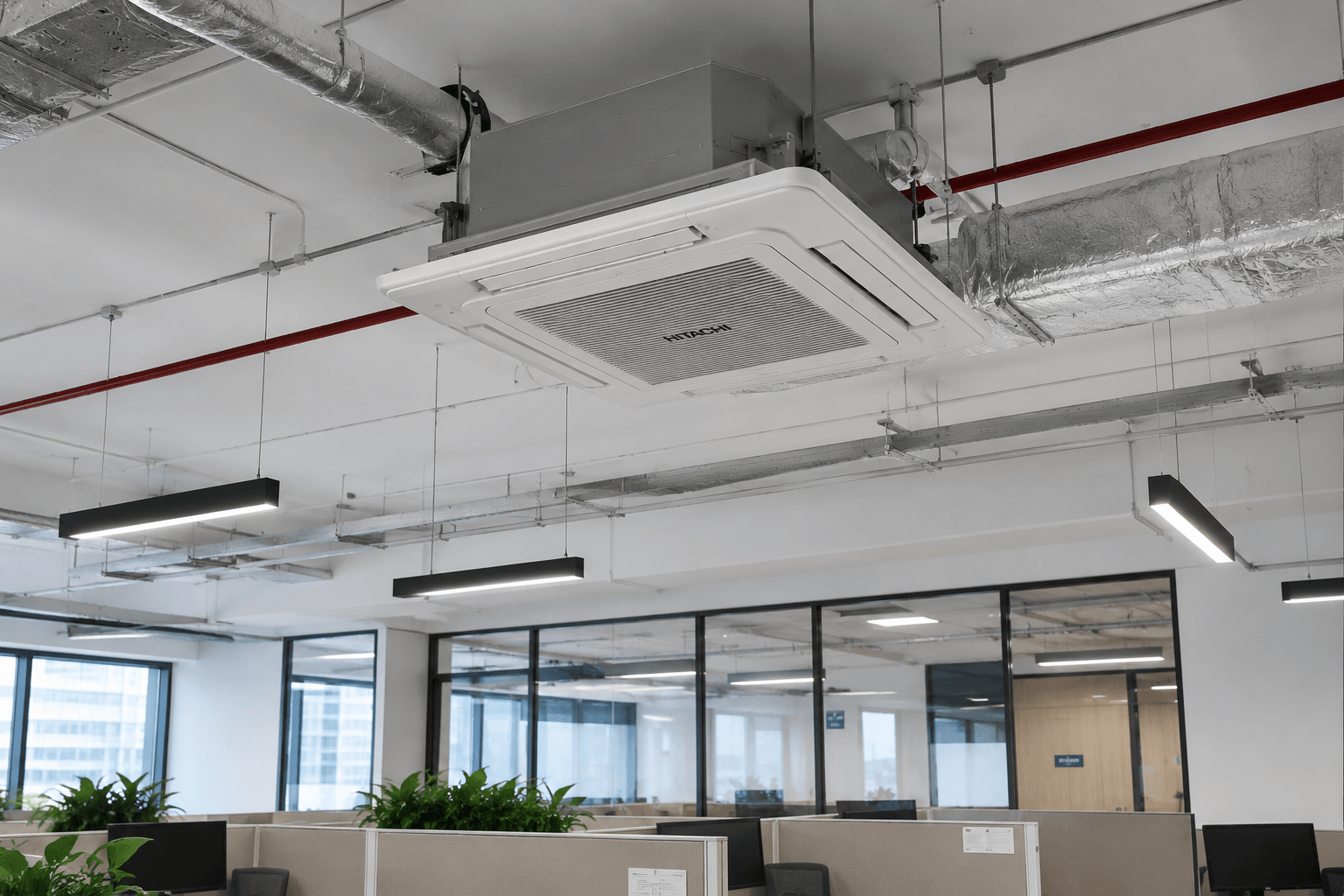
If you’re planning cooling for an office in Chennai and Hitachi is on your shortlist, there’s a good chance you’ve already looked at a few options and hit a wall. Hitachi central AC systems come in more than one format and choosing between cassette, ductable and VRF is not as straightforward as picking a tonnage and moving on. Each system works differently and suits a different kind of space. Getting this decision right from the beginning saves you from expensive corrections later.
At Techno Power Aircons we’ve been handling commercial AC installations across Chennai since 1982. This post breaks down exactly how each Hitachi system works and which one makes the most sense based on your office layout, size and how the space is actually used.
Why Hitachi for Commercial AC in Chennai?
Before getting into system types, it helps to understand why Hitachi keeps coming up for commercial buyers in Chennai. The brand has a long track record in tropical climates and their 2026 lineup is engineered to maintain consistent cooling even in ambient temperatures up to 54°C, which matters in a city where May and June afternoons push outdoor units hard.
Their commercial range covers cassette ACs, ductable systems and full VRF setups with multiple indoor unit configurations. The VRF platform also supports airCloud Pro, Hitachi’s centralised IoT control system that lets facility managers monitor and adjust zones from a single app – useful for offices managing cooling across multiple floors or departments.
For an authorised Hitachi VRF dealer in Chennai who stocks the full commercial range, Techno Power Aircons is your direct point of contact.
The Three Options: A Quick Overview
Before comparing them in detail, here’s how the three system types differ at a glance:
| System Type | Best For | Installation Complexity | Zone Control |
| Cassette AC | Small to mid offices with false ceiling | Low to moderate | Per unit |
| Ductable AC | Large halls, conference rooms, open floors | Moderate to high | Limited (zone with dampers) |
| VRF System | Multi-room offices, multi-floor buildings | High | Full independent zone control |
Hitachi Cassette AC: The Most Common Choice for Mid-Size Offices
Walk into most offices in Chennai and you’ll find cassette ACs fitted into the false ceiling grid. There’s a reason for that. The unit sits flush in the ceiling, distributes air in four directions and doesn’t take up wall space. It’s clean, practical and works well for floor areas between 200 and 600 square feet per unit.
Hitachi’s cassette range includes both 2-ton and 4-ton inverter models. The 4-way cassette is especially popular in offices because it avoids cold spots in corners. For a clinic waiting room, a mid-size meeting room or an individual cabin layout, this system is usually the right call.
You can explore the full scope of cassette AC installations in Chennai to understand how different businesses use these systems and what the installation process involves.
When cassette AC makes sense:
- Office floor between 500 and 2000 square feet
- False ceiling already in place or planned
- Moderate budget with no need for zone-by-zone temperature control
- Small to medium commercial spaces like clinics, coaching centres or showrooms
Hitachi Ductable AC: For Larger Spaces That Need Concealed Airflow
Ductable systems push conditioned air through ducts and ceiling vents rather than from a single visible unit. The indoor unit sits in the ceiling plenum and all you see in the space itself are diffuser grilles. This is the right choice for large conference halls, hotel lobbies, training rooms or any open-plan layout where a single cassette unit won’t distribute air evenly.
Hitachi’s ductable range handles higher static pressure requirements which makes it practical for longer duct runs in large commercial buildings. If your office has an open floor plan of 1500 square feet or more with a single open zone, ductable is usually more efficient than placing multiple cassette units.
The tradeoff is installation complexity. Duct routing requires ceiling space and needs to be planned carefully during construction or renovation. Retrofitting ducts into an existing building is possible but adds cost. For proper load calculations and duct design, working with experienced HVAC Engineering Services makes a significant difference in how the system performs after commissioning.
When ductable AC makes sense:
- Large open areas – training rooms, conference halls, reception areas
- New construction or renovation where ceiling work is already happening
- Spaces where you want zero visible indoor units
Hitachi VRF System: For Multi-Zone and Multi-Floor Offices
VRF is in a different league compared to cassette and ductable setups. One outdoor unit connects to multiple indoor units across different rooms or floors and each zone can be set to its own temperature independently. That’s the core advantage: your server room can run at 20°C while the main office floor runs at 24°C and the MD’s cabin runs at 22°C, all from the same outdoor system.
For a deep look at how this works commercially, the VRF/VRV AC guide for commercial systems covers the technical and practical details clearly.
Hitachi VRF also integrates with building management systems through the airCloud Pro platform, which is increasingly relevant for IT parks, hospitals and multi-tenant office buildings along OMR and Ambattur. It’s also modular, so you can expand the system later by adding indoor units without replacing the outdoor unit, provided the original design accounts for that.
The main consideration is upfront investment. VRF costs more than cassette or ductable for a comparable floor area. But over five to seven years of operation, the energy savings from variable capacity operation and the reduced maintenance from fewer outdoor units tend to make up the difference, particularly in a city like Chennai where AC runs ten to twelve months a year.
For centralised AC installation in Chennai projects that require full system design including VRF, our team handles everything from load calculation to commissioning.
When VRF makes sense:
- Offices with multiple rooms requiring different temperatures
- Multi-floor buildings needing centralised control
- Buildings where long-term energy efficiency is a priority
- Hotels, hospitals, IT parks and premium commercial spaces
Side-by-Side Comparison: Cassette vs Ductable vs VRF
| Factor | Cassette AC | Ductable AC | VRF System |
| Space suitability | Small to mid-size rooms | Large open areas | Multi-room or multi-floor |
| Visibility | Ceiling-flush unit | Fully concealed via ducts | Fully concealed |
| Zone control | Per unit, independent | Limited | Full independent per zone |
| Installation cost | Moderate | Moderate to high | High |
| Energy efficiency | Good | Good | Excellent (variable capacity) |
| Expansion flexibility | Low | Low | High |
| Best suited for | Clinics, cabins, showrooms | Conference halls, large floors | Offices, hotels, IT parks |
What Most Office Buyers Get Wrong
In many cases people choose a system based on familiarity rather than actual requirements. Cassette ACs are the default because they’re the most visible option in most offices. But in a 4000 square foot floor with eight cabins and a common area, cassette units struggle to maintain even temperatures without running constantly – and that drives up electricity bills.
Equally, not every office needs VRF. If you have a single open floor of 1000 square feet and no complex zoning requirement, a well-designed cassette or ductable setup will do the job at a fraction of the cost. The right answer depends on your floor plan, how many zones you need and what the space will be used for day to day.
For a quick brand comparison before finalising your choice, the best AC brands in Chennai for 2026 gives useful context on where Hitachi sits relative to other commercial options.
After Installation: Keeping the System Running Well
Whichever system you choose, maintenance is not optional in Chennai’s climate. Coastal humidity and dust mean filters need attention more frequently than in drier cities and outdoor unit coils can degrade faster without proper care.
For commercial systems, scheduled servicing through an AC AMC in Chennai is the most practical approach. It removes the guesswork from maintenance scheduling and means problems get caught early before they become breakdowns.
If replacement components are needed, having access to a reliable AC spare parts dealer in Chennai reduces downtime considerably – particularly for commercial systems where a breakdown affects an entire floor of staff.
Conclusion
Hitachi central AC is a strong choice for Chennai offices across all three formats – cassette, ductable and VRF. The right system depends on your floor plan, the number of zones you need, your ceiling setup and your long-term budget. None of these three is universally the best option. The best option is the one that fits your actual space and how it’s used.
If you’re not sure which direction to go, a proper site assessment before you commit to any system is worth the time. Getting the design right from the start is far cheaper than correcting it after installation.
Get in Touch with Techno Power Aircons
Frequently Asked Questions
Q1: Is Hitachi central AC suitable for a small office in Chennai?
Yes, Hitachi’s cassette AC range works well for small to mid-size offices. A 2-ton cassette unit typically covers 200 to 400 square feet of well-insulated office space. For offices with multiple rooms or cabins, you can combine multiple cassette units or consider a small VRF setup depending on the budget.
Q2: What is the difference between Hitachi cassette AC and VRF system?
A cassette AC is a standalone unit fitted in the ceiling that covers one zone. A VRF system connects multiple indoor units – including cassette types – to a single outdoor unit and allows each room to be controlled independently. VRF is more efficient for multi-room setups but costs more upfront.
Q3: How long does Hitachi central AC installation take for an office?
A cassette AC installation for a small office typically takes one to two days. Ductable and VRF systems take longer depending on the scale – a mid-size office VRF project usually takes three to seven days for installation and commissioning.
Q4: Does Hitachi VRF system work well in Chennai’s coastal climate?
Yes. Hitachi designs its commercial systems for tropical conditions and high ambient temperatures. The outdoor units are rated for sustained operation up to 54°C and the coatings on heat exchangers are suited for humid coastal environments like Chennai.
Q5: How do I choose between cassette and ductable AC for my Chennai office?
The main deciding factors are floor area and ceiling availability. Cassette ACs work well for rooms under 600 square feet with a standard false ceiling grid. Ductable systems are better for large open areas where you want uniform air distribution through ceiling vents without visible indoor units. If you have multiple zones with different temperature requirements, VRF is the more practical long-term choice.
Leave a Reply