
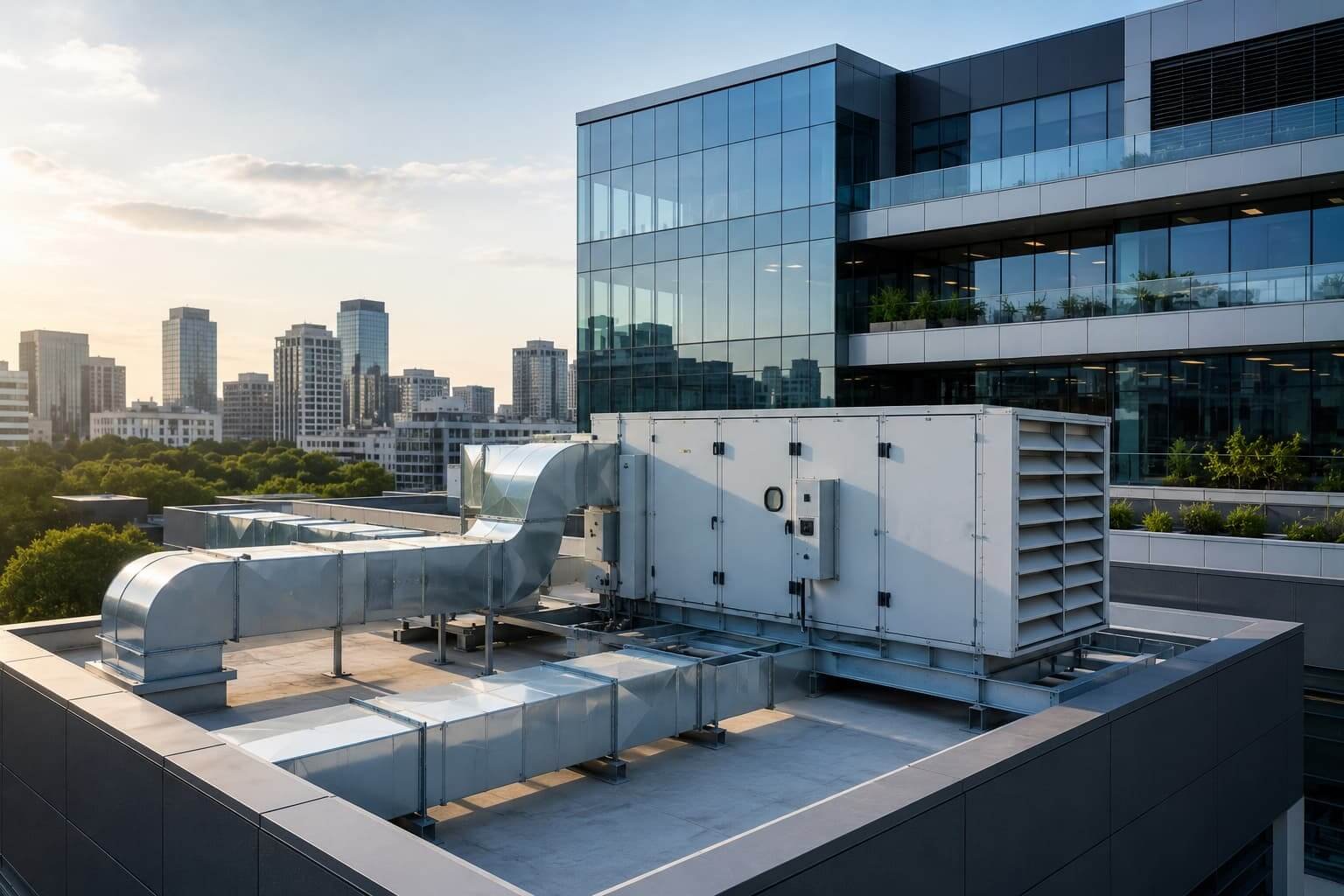
Manage a commercial building long enough and at some point a contractor will casually drop the phrase types of AHU into conversation like you’re supposed to already know what that means. Truth is most people don’t, and honestly it’s not that deep once you sit down and actually unpack it. We spend our days around this stuff, offices, malls, hotels, the occasional factory floor scattered across Chennai. So let’s do the thing most explainers skip, actually answer what is an AHU first, then get into the different types and why picking the wrong one costs more than people think.
What Is an AHU?
Basics first, always. An AHU, Air Handling Unit if you want it spelled out, is a big chunk of equipment that pulls air in, does something to it, and pushes it back out through ductwork into a building. Put like that it barely sounds technical at all. Difference between this and a regular split AC in your living room is scale, one cools a room, the other handles a floor, sometimes an entire building.
Inside you’ve got filters, coils that heat or cool depending on the season, fans, dampers, a whole mess of parts working together in one box. If you need a comparison, it’s kind of like a building’s lungs. Air in, air out, conditioned somewhere in between so nobody’s sitting there sweating or shivering at their desk.
Why Understanding Types of AHU Matters
Here’s the part people miss. No two buildings need the same setup. What a hospital needs from its air handling looks nothing like what a shopping mall needs, and a factory floor is basically playing a different sport altogether. That’s the actual reason bothering to learn the different types of AHU pays off, it stops someone from making a call that ends up costing real money.
Pick wrong and here’s roughly what happens:
- Energy bills climb and nobody can quite explain why
- Air inside just never feels right, stuffy or too dry
- The unit breaks down way more than it should
- One end of the building freezes while the other bakes
Spend a bit more time getting it right upfront and you skip most of that mess later. Learned that one the hard way more than once.
Common Types of AHU Used in Commercial Buildings
1. Packaged AHU
The one you’ll run into most, honestly. Fan, coils, filters, dampers, all bolted together in a single unit straight from the factory. Cheaper, quicker to install, and works well enough for mid sized places like offices or a retail store.
2. Modular AHU
Comes apart in pieces and gets put together once it’s actually on site. Makes more sense for bigger buildings where trying to cram one packaged unit in just wouldn’t work. Nice thing is you can add or swap sections later without ripping the whole system out.
3. Rooftop AHU
Sits on the roof, does exactly what the name suggests. People go for these because the maintenance crew doesn’t have to walk through occupied space to reach it, plus you’re not losing floor area to a giant box sitting indoors. You’ll spot these on malls, warehouses, the bigger office parks.
4. Horizontal AHU
Lies flat, usually stuffed into a ceiling void or a small dedicated room. Works where there’s not much height to play with but plenty of horizontal room, think false ceilings running the length of a corridor.
5. Vertical AHU
Stands upright, usually parked inside a mechanical room built just for it. Makes sense when ceiling clearance is tight but there’s decent floor space to spare in the equipment area.
6. Fresh Air AHU
Most units just cycle the same indoor air over and over, round and round. This one pulls air from outside instead and conditions it before pushing it in. You’re seeing more of these in offices and hospitals now that indoor air quality rules keep getting tighter.
7. Double Skin AHU
Two layers of casing with insulation packed between them. Cuts down heat loss, keeps noise down, and helps avoid that condensation issue that shows up sometimes. Usually reserved for the bigger commercial or industrial jobs where cutting corners just isn’t an option.
Benefits of Choosing the Right AHU Type
Get the type right and it shows pretty quickly.
Energy use drops because the unit’s actually sized for what the building needs, not guessed at. Air quality improves since the filtration matches the space instead of being some one size fits all setup. Maintenance costs stay lower because nothing’s being pushed past what it can handle. The equipment lasts longer too, simply because it was matched properly from the start. And comfort stays even across the building rather than one wing always complaining it’s too hot or too cold.
Working with a solid AC dealer in Chennai takes a lot of the guesswork out of this, since they can walk the site and just tell you what actually fits instead of pushing whatever’s easiest to sell.
How AHUs Work With VRF and VRV Systems
Plenty of commercial spaces pair an AHU with a VRF or VRV system, mostly for better control over zoning. The AHU takes care of fresh air treatment and distribution, while the VRF or VRV handles temperature independently zone by zone.
You’ll see this combo a lot in big office towers and hotel projects where one section needs to run cooler than another at the exact same time. We end up on quite a few VRF/VRV, AHU Air Conditioners jobs that blend both together, and the comfort difference is noticeable once it’s done right.
Choosing a Reliable AHU Brand
Not every AHU is built the same and brand quality really does matter more than people expect once you’re a few years down the line. Glancing at a list of the top 5 ac brands in India isn’t a bad place to start if you’re comparing blind. Same goes for scrolling through the top ten AC brands in 2026, gives you a rough feel for who’s actually pushing things forward versus who’s just coasting on an old reputation.
Names that keep popping up under best AC brands in Chennai tend to share one thing, decent after sales support, not just a nice looking spec sheet. Whether you’re browsing AC brands in Chennai for a fresh install or torn between one AC brand and another, talking to someone who actually installs and services these day to day saves a lot of back and forth.
Why Professional Installation Matters
You can’t really wing an AHU install, not properly anyway. Ductwork layout, load calculations, getting the whole system balanced right, it all needs someone who’s actually done it before. Bringing in qualified HVAC Contractors in Chennai means the unit gets sized correctly and installed the way it’s meant to be, not some improvised workaround.
We also handle HVAC Engineering Services, everything from the first design sketch through to commissioning, so what actually gets built is shaped around the space itself rather than pulled from some template that half fits.
Ongoing Support and Maintenance
Even a solid AHU needs upkeep, filters swapped, coils cleaned, controls checked now and then, none of it’s really optional if you want it lasting. Sticking with dependable HVAC dealers in Chennai for maintenance keeps things running the way they should, not just in year one but for the long haul.
We also run AC AMC in Chennai so owners aren’t blindsided by a breakdown at the worst possible moment. And when parts eventually give out, because they will eventually, we work with trusted AC Spare Parts Dealers in Chennai to get genuine components without the usual weeks long wait.
Expert Guidance for Your Building
Every commercial space has its own quirks, size, foot traffic, what it’s actually used for on a daily basis. Our HVAC Consultants in Chennai can look the building over and tell you plainly which AHU type fits, along with whatever VRF or VRV pairing makes sense alongside it.
For anyone managing sites spread across the state, our reach through VRF dealers in Tamil Nadu and VRV dealers in Tamil Nadu keeps things consistent no matter which location you’re talking about.
And if a particular brand isn’t quite what you had in mind, we can just as easily talk you through Haier VRF AC Dealers in Chennai or Blue Star AC Dealers in Chennai depending on what the project needs and what the budget looks like.
Final Thoughts
Getting a handle on the different types of AHU is really the starting point for a cooling system that works with your building instead of fighting it every day. From packaged units to the double skin designs, each one’s suited to a specific job depending on size, layout, and how the space actually gets used.
This isn’t something worth guessing your way through. It takes an honest look at the building, real planning, and installation from people who’ve actually done commercial HVAC work, not just read about it somewhere.
Ready to Find the Right AHU for Your Building?
Sorting through every type of AHU out there doesn’t have to be a headache. Our team at Techno Power Aircons has spent years helping commercial properties pick, install, and keep up the right air handling systems for whatever their space actually calls for.
Reach out whenever you’re ready and let’s figure out something built around your building, not whatever happens to be easiest to sell.
Frequently Asked Questions
- What is an AHU used for in commercial buildings?
An AHU treats and pushes air through a building. Filtration, heating, cooling, airflow, all handled centrally for spaces too big for individual room units to make sense.
- What are the most common types of AHU for offices?
Packaged and modular units tend to be the default choice for office buildings, mostly because they hit a decent balance between cost and how well they perform.
- How do I know which type of AHU suits my building?
Comes down to available space, ceiling height, how many people move through daily, and what your air quality needs actually look like. Getting someone to actually assess it beats guessing every single time.
- Can an AHU work with a VRF or VRV system?
Yes, and it happens all the time. The AHU handles fresh air treatment while VRF or VRV manages zone based temperature control across the same building.
- How often should an AHU be serviced?
Filters usually want attention every one to three months, and a proper full inspection twice a year stops the system from quietly losing efficiency without anyone noticing until the bill shows up.
Leave a Reply