
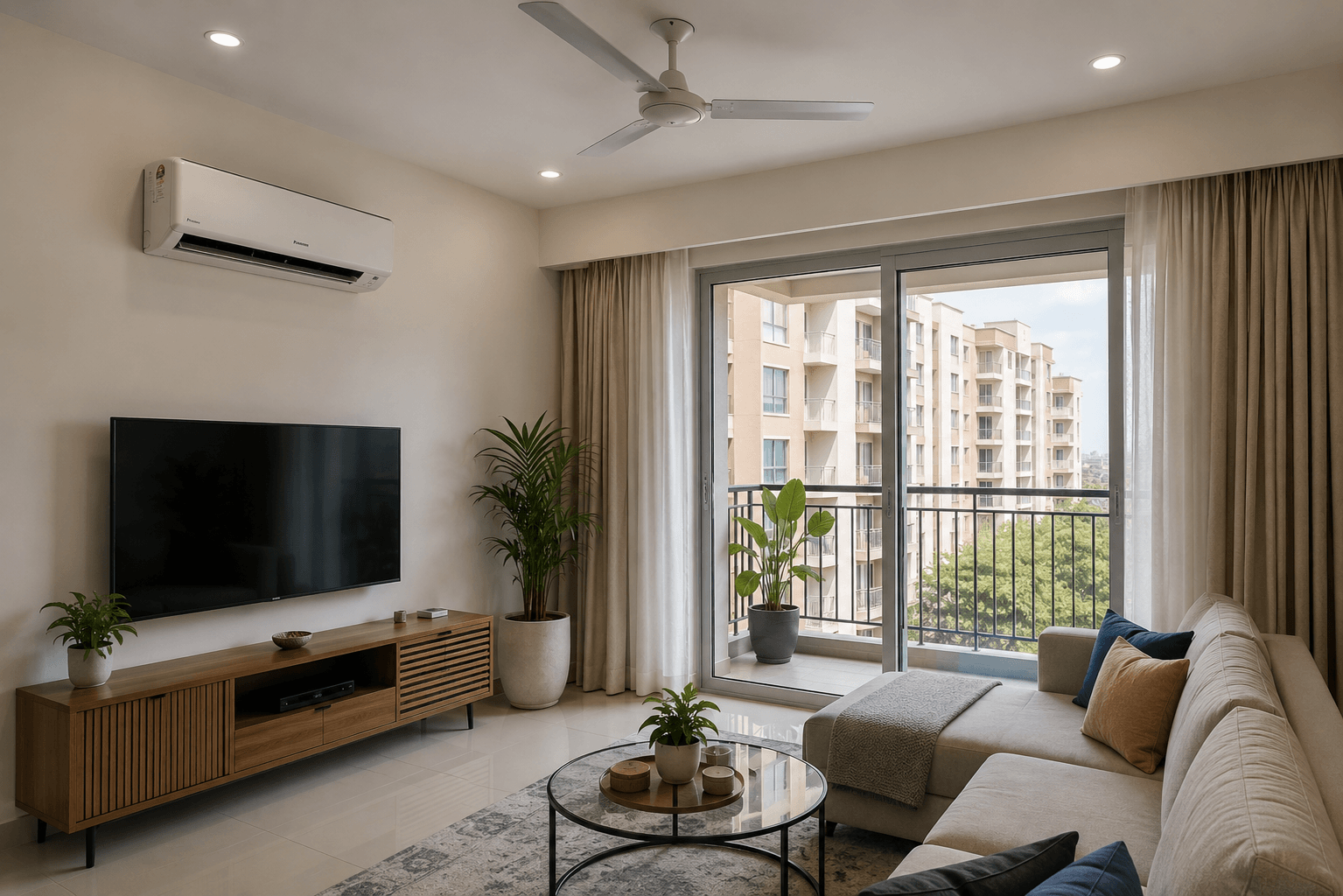
Right now, Chennai is sitting at 35°C with a feels-like temperature pushing 42°C. The humidity is close to 55% and climbing. If you live in a flat in Mylapore, Adyar, T Nagar, or OMR – you already know that stepping indoors without a good AC is not really an option anymore between March and June.
At Techno Power Aircons, we have been selling and installing ACs across Chennai since 1982. So when customers walk in asking “which AC is best for my apartment,” we do not give a one-size-fits-all answer. The right AC depends on your room size, which floor you are on, whether your flat faces west, and how many hours a day you run it.
Here is our honest guide – no brand bias, just what actually works.
How Chennai’s Climate Changes What You Should Buy
Chennai is not like Delhi or Bangalore when it comes to AC selection. This city has three things that stress an AC harder than most places in India:
High ambient temperature. From April to June, outdoor temperatures cross 38–40°C regularly. Your AC’s outdoor unit is sitting in that heat trying to reject hot air. A unit not rated for high ambient performance will struggle badly and your electricity bill will show it.
Coastal humidity. Areas like Adyar, Besant Nagar, Nungambakkam, and ECR get salt-laden air from the sea. That slowly corrodes the heat exchanger coils on standard ACs. After two or three seasons, cooling capacity drops noticeably. This is why we always recommend models with Blue Fin or anti-corrosion coated coils for coastal Chennai homes.
Long running hours. Most Chennai apartments run their AC 8 to 12 hours a day for at least 6 months of the year. A non-inverter AC in that scenario will cost you ₹3,000–4,500 more in electricity every month compared to a 5-star inverter model of the same tonnage.
These three factors should guide every decision you make.
Step 1: Get the Tonnage Right for Your Room
The most common mistake we see is people buying a 1-ton AC for a 200 sq ft room in Chennai – and then wondering why the room never cools down properly on a May afternoon.
Chennai’s heat load is higher than the national average. The general rule of 1 ton per 120–150 sq ft holds for most cities. In Chennai, especially for rooms facing west or with large glass windows, add 0.5 ton on top of that.
Use this as your starting guide:
- Up to 120 sq ft (small bedroom, study): 1 ton
- 120–180 sq ft (standard bedroom): 1.5 ton
- 180–250 sq ft (master bedroom, large bedroom): 2 ton
- 250–400 sq ft (living room, combined space): 2–2.5 ton
If your flat is on the top floor or has a south/west-facing window wall, always go one step higher. The extra cooling capacity costs almost nothing in electricity with an inverter compressor but makes a real difference in comfort during peak afternoons.
Step 2: Always Choose Inverter Over Fixed Speed in Chennai
This one is not even a close call anymore. A fixed-speed AC turns on at full blast, cools the room, turns off, and repeats. Every on-off cycle uses a surge of electricity. In Chennai, where the AC runs almost continuously during summer, that cycle adds up fast.
An inverter AC adjusts its compressor speed continuously. It runs slow when the room is almost cool and speeds up only when needed. In a Chennai summer with 8-hour daily use, a 5-star inverter AC will save you ₹800–1,200 a month compared to a 3-star fixed-speed model of the same capacity.
The price difference between a 3-star non-inverter and a 5-star inverter has come down significantly in 2026. Most good 1.5-ton inverter models from trusted brands are now available in the ₹38,000–48,000 range. You will recover that difference in electricity savings within two seasons.
Step 3: Which Brand Is Right for a Chennai Apartment?
This depends on your priority – raw cooling performance, air quality, after-sales reliability, or budget. Here is what we have seen work well in Chennai apartments specifically:
For pure performance in extreme heat: Daikin is the benchmark. Their high-ambient models keep cooling effectively even when the outdoor temperature is above 50°C. The compressor reliability over 8–10 years is hard to match. If your flat faces west and you need the room to cool fast from a 38°C room temperature – Daikin is where we would point you.
For coastal apartments (Adyar, Besant Nagar, ECR, Santhome): Mitsubishi Electric and Panasonic both use strong anti-corrosion coatings on their heat exchangers. Panasonic’s Shield Blu+ coating and Mitsubishi’s pre-coated fins handle Chennai’s salt air better than most. Panasonic also added nanoe™ air purification in 2026 models, which helps with indoor air quality on days when you keep windows shut.
For value and service network: Voltas and Carrier offer solid 5-star inverter models with good after-sales coverage across Chennai. If budget matters and you want a reliable brand with technicians available in your area quickly – these two are worth looking at.
For feature-rich models with smart controls: Hitachi and Samsung have pushed hard on Wi-Fi connectivity and smart scheduling in their 2026 range. If you travel frequently and want to pre-cool your flat before you get home – these brands have that covered well.
Do You Need a Split AC or a Cassette AC for Your Apartment?
For most Chennai apartments, a split AC is the right choice. It is wall-mounted, easy to install, and works perfectly in standard bedroom or living room setups where wall space is available.
A cassette AC makes sense if your flat has a false ceiling and a larger open-plan area – like a combined living and dining space above 300 sq ft. Cassette units throw air in four directions from the ceiling, which means the entire room cools evenly without any corner being left warm. We install a lot of cassette ACs in Chennai for premium apartments and penthouses where the living space is large.
For standard 2 or 3 BHK apartments, split ACs for each room is the most practical approach.
What About AC Maintenance in Chennai?
An AC that is not serviced properly in Chennai’s climate loses 15–20% of its cooling capacity within one season. Dust and pollen from the city air clog the filters. Salt particles from coastal areas build up on the condenser coils outdoors.
We recommend a filter clean every 4–6 weeks during summer and a full professional service before the monsoon. If you want scheduled, hassle-free maintenance, our AC AMC in Chennai covers everything – filter clean, coil check, refrigerant top-up if needed, and drain flush before the rains hit.
A Quick Word on Installation
Getting the installation right matters almost as much as picking the right AC. The outdoor unit placement, pipe length, drain line angle, and electrical load all affect how well your AC performs and how long it lasts. This is especially true during monsoon installation when water ingress during fitting can cause long-term problems.
We have been installing ACs across Mylapore, Adyar, T Nagar, Nungambakkam, OMR, and ECR for over four decades. We know which apartments have tricky outdoor unit placements, which buildings have voltage fluctuation issues, and which areas need extra corrosion protection. That local knowledge is something a generic online purchase cannot give you.
Talk to an Expert
Top 5 FAQs: Best AC for Chennai Apartment
1. Which AC tonnage is best for a standard bedroom in a Chennai apartment?
For a standard bedroom of 120–160 sq ft in Chennai, a 1.5-ton inverter split AC is the right choice. If the room is on a top floor or faces west and gets direct afternoon sun, go with a 2-ton model. Chennai’s heat load is higher than average Indian cities, so it is always better to size up slightly rather than have an undersized unit running at 100% all day.
2. What is the best AC brand for Chennai’s humid and coastal climate?
For coastal Chennai areas like Adyar, Besant Nagar, Santhome, and ECR, Daikin, Panasonic, and Mitsubishi Electric are the strongest choices. These brands use anti-corrosion coatings on their heat exchangers that hold up better against salt air compared to standard coil finishes. For inland areas like T Nagar, Anna Nagar, and Vadapalani – Daikin, Hitachi, and Voltas all perform reliably.
3. Is a 5-star inverter AC worth the extra cost for a Chennai home?
Yes, clearly. In Chennai where ACs run 8–12 hours daily for 6+ months a year, a 5-star inverter AC can save ₹8,000–12,000 per year in electricity compared to a 3-star non-inverter model of the same capacity. The price premium on a 5-star inverter is usually ₹5,000–8,000 more. You recover that in one summer season.
4. Should I buy a split AC or cassette AC for my Chennai apartment?
For most apartments with standard rooms, a split AC is the practical and cost-effective choice. A cassette AC is better suited for large open-plan living areas above 250–300 sq ft with a false ceiling. Cassette units distribute air from four directions simultaneously, which removes hot spots in bigger rooms. If your flat has a designer interior and you want the unit to be invisible inside the ceiling – cassette is worth the extra investment.
5. How often should I service my AC in a Chennai apartment?
Clean your air filter every 4–6 weeks during summer. Get a full professional service before the monsoon – typically in May or early June. This should include coil cleaning, drain line flushing, refrigerant check, and electrical inspection. For coastal Chennai homes, a post-monsoon check in October is also recommended because the rainy season accelerates coil corrosion. An annual maintenance contract with a local dealer makes this easier to stay on top of.
Leave a Reply