
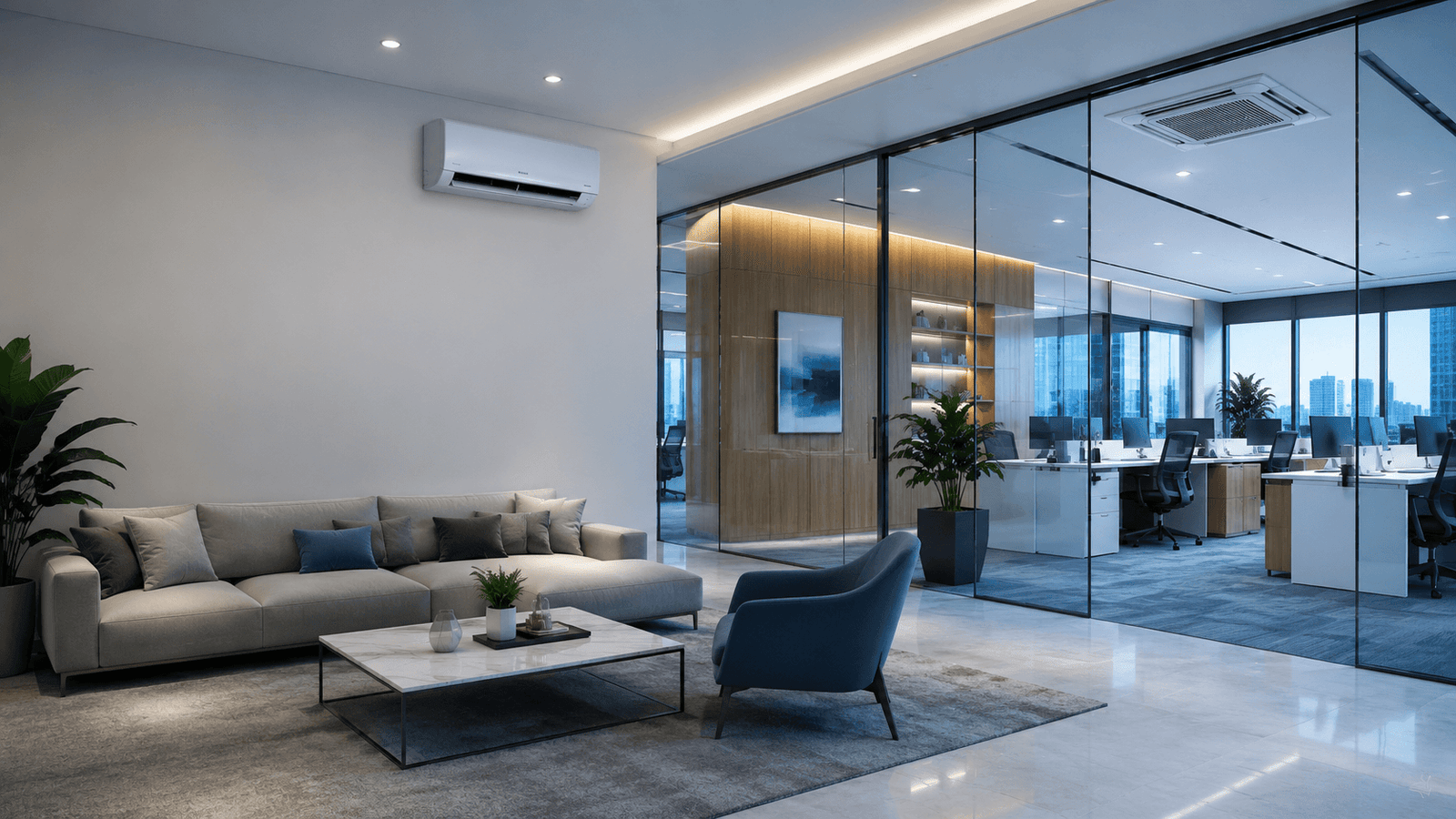
Okay so here’s something I get asked way too often, usually by someone standing in their half finished office space looking kind of lost: why can’t they just put in the same AC they have at home? Fair question honestly. The commercial hvac vs residential hvac thing trips up a lot of people in Chennai, and I get why. On paper an air conditioner is an air conditioner, right? Except it really isn’t, not once you dig into it. At Techno Power Aircons we run into this mix up constantly, and the short version is that a home and a commercial building are basically solving two totally different puzzles. A house just needs to keep a few people comfortable. A building full of offices needs to keep functioning, period.
Anyway, let me try to untangle this a bit so it actually makes sense before you drop money on the wrong setup.
Why Commercial HVAC vs Residential Systems Are Not the Same
Think about it this way. Your house has your family, maybe four or five rooms, and heat that builds up in pretty predictable ways (afternoon sun on the west wall, kitchen gets warm around dinner, that sort of thing). A commercial building? Could have two hundred people walking in and out all day, computers running nonstop, kitchens or server rooms throwing off heat nobody accounted for. That one difference kind of blows up the whole design process.
Most homes just need a split unit or maybe a small ductable system if the place is big enough. Commercial spaces usually need something with a lot more muscle, which is where VRF/VRV, AHU air conditioners come in, since they can juggle multiple zones without burning power on rooms nobody’s sitting in.
Load Calculation and System Design
This is honestly where things fall apart for people who try to DIY the decision.
- Homes just need a rough room by room load calc. Size of the room, how much sun it gets, how many people usually hang around in it.
- Commercial buildings need way more than that. Someone has to study how people actually move through the space, how much heat the equipment throws off, ventilation rules, and whether the company plans to add another floor of staff in two years.
Skip this step on a commercial job and it gets expensive fast, which is exactly why most builders bring in real HVAC Engineering Services before anyone starts bolting units to walls.
Zoning Matters More in Commercial Spaces
Not every corner of an office needs to be the same temperature, and honestly it shouldn’t be. A server room runs hot no matter what. A reception area near the front door gets blasted by outside heat every time someone walks in. A manager’s cabin might barely need cooling at all. Commercial systems are built with that kind of zoning baked in from day one, while most homes get by fine with one or maybe two zones tops.
Types of Systems Used in Each Setting
Quick rundown, roughly, of what tends to show up where.
Residential:
- Split ACs, one per room basically
- Small ductable setups for bigger homes or villas
- Sometimes a cassette unit if the living room’s large
Commercial:
- VRF and VRV for that multi zone flexibility
- AHU based centralised setups, common in malls, hospitals, big office floors
- Ductable systems scaled way up for open plan layouts
If you’re still not sure which bucket your building falls into, honestly just talk to someone. A decent HVAC dealers in Chennai team can walk you through it in ten minutes and save you from buying way more (or less) capacity than you need.
Installation Complexity and Timeline
Home jobs, done in a day, sometimes two if the wiring’s a mess. Commercial jobs are a whole different animal. You’ve got electricians to coordinate with, ducting work that means tearing into ceilings, sometimes even structural sign offs before a single indoor unit goes up on the wall.
Bigger commercial fit outs usually pull in dedicated HVAC Contractors in Chennai who handle the entire mechanical side, not just the cooling piece.
Maintenance and Service Requirements
Home AC maintenance is pretty basic honestly. Clean the filter, top up the gas when it’s low, done. Commercial systems need a stricter routine because if the cooling drops out mid day, that’s not just uncomfortable, that’s lost business, sometimes even a compliance headache depending on the building.
Most commercial clients end up signing on for a real AC AMC in Chennai so servicing happens on a schedule instead of only after something’s already broken. It also helps to have a decent line to AC Spare Parts Dealers in Chennai, because in a commercial setup one bad component can knock out cooling for an entire floor, and that’s never a fun call to get.
Cost Differences You Should Expect
Commercial systems cost more going in, no way around that, it’s just the scale of them. But they’re also built to run for hours on end without giving up. Residential systems are cheaper up front but they’re not really made for that kind of nonstop, heavy duty grind a commercial site puts them through.
Quick HVAC System Comparison
| Factor | Residential HVAC | Commercial HVAC |
| Typical system | Split, small ductable | VRF, VRV, AHU |
| Load calculation | Simple, room based | Detailed, engineering led |
| Zoning | One or two zones | Multiple zones |
| Installation time | 1 to 2 days | Weeks, depending on scope |
| Maintenance | Basic, occasional | Scheduled AMC, priority support |
| Running hours | Few hours daily | Often 10 plus hours daily |
That table’s a decent starting point but honestly every building has its own weird quirks worth talking through with someone who’s actually seen the space.
Choosing the Right Brand and Dealer
Brand matters just as much as the system type, maybe more than people expect. For homes, a lot of Chennai households just stick with names covered in our best ac brand picks, nothing fancy, just reliable stuff that holds up.
Commercial jobs lean toward heavier hitters though. Our writeup on the top 5 ac brands in India covers the names that keep showing up in offices and factories over and over. There’s also our top ten AC brands in 2026 list if you want a wider view before deciding.
For VRF projects specifically, people ask a lot about our Blue Star VRF AC Dealers in Chennai options, and separately about our Blue Star AC Dealers in Chennai setups for smaller commercial jobs. Both come up constantly in the same conversation honestly, just depends on scale.
If the project’s not even in Chennai, that’s fine too, we work with folks through our VRF dealers in Tamil Nadu and VRV dealers in Tamil Nadu network, so location really isn’t much of a limitation these days. And for bigger builds, a lot of owners bring in HVAC Consultants in Chennai before locking anything in, which honestly isn’t a bad habit to pick up.
Working With the Right Partner
Whether it’s one split unit for a bedroom or a full commercial rollout across five floors, working with a proper AC dealer in Chennai just makes the whole thing less painful. Techno Power Aircons has been putting in AC brands in Chennai since 1982, so at this point we’ve basically seen every kind of building throw every kind of cooling problem at us. Doesn’t matter which AC brand you’re leaning toward either, or what corner of HVAC your project touches, we’ve probably dealt with something close to it before.
Final Thoughts
At the end of the day the commercial hvac vs residential question comes down to scale, how the space actually gets used, and what it costs to run long term, not just how big the room is. Getting someone to look at it properly before you buy saves you years of dealing with a system that never quite keeps up.
If you’re planning a new install or finally replacing something ancient, just talk to us at Techno Power Aircons. We’ll look at your space, walk you through what actually fits, and handle it start to finish, supply, install, upkeep, all of it. Reach out whenever, we’re happy to help you figure out what your building actually needs.
FAQs
- Is commercial HVAC always more expensive than residential HVAC?
Upfront, usually yes, mostly because of the scale and the engineering work behind it. But over time a properly sized commercial system can actually work out cheaper per square foot than running a bunch of smaller residential units side by side.
- Can a residential AC be used in a small office?
For a tiny office, one or two rooms, sure a split AC can hold up fine. Once the headcount grows or equipment load goes up though, it starts making more sense to shift toward VRF or ductable.
- How often should commercial HVAC systems be serviced compared to home ACs?
Commercial units usually need checks every month or at least every quarter, just because they’re running so many more hours. Home ACs can often coast on a service every three to six months.
- Do commercial and residential systems use the same refrigerants?
Not always. Commercial setups, VRF especially, often run different refrigerant volumes and piping made for longer runs and multiple indoor units hanging off one outdoor unit.
- What is the biggest mistake people make when choosing between the two?
Undersizing a commercial system to save a bit of cash upfront. It almost always backfires, higher bills, more breakdowns, and honestly it ends up costing more than just doing it right the first time.
Leave a Reply