

Indian homes and businesses are moving beyond one room, one AC. As energy tariffs rise and comfort expectations change, many buyers are evaluating VRF air conditioning. Yet the internet is full of half truths that can derail a smart purchase. If you are shortlisting VRF systems in 2026, here are the myths you should ignore and the practical checks that matter in India.
A Simple Overview of VRF Air Conditioning
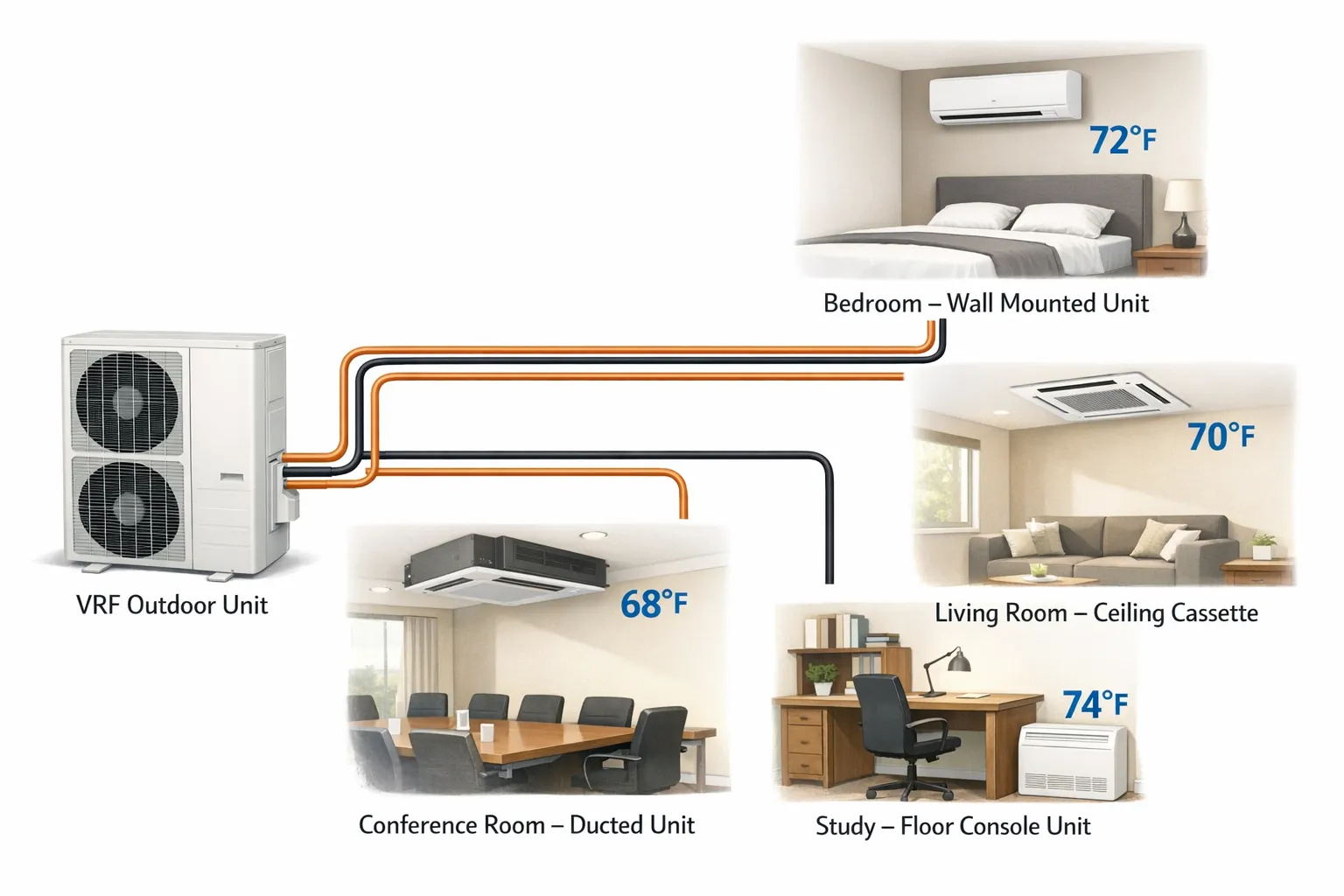
Variable Refrigerant Flow, also called VRF, uses inverter driven compressors and electronic expansion valves to precisely control the amount of refrigerant each indoor unit receives. One outdoor unit can serve many indoor units, so you can cool or heat different rooms at different set points while the system modulates to match real load. Daikin uses the term VRV for the same core technology. If you are comparing the two, explore the details of VRF Air Conditioners vs VRV Air Conditioners. If you prefer to see how VRF compares for Chennai’s weather read more on why VRF air conditioning is perfect for Chennai’s climate.

Myth 1: VRF is only for large commercial buildings
Reality, VRF is scalable. Mini VRF configurations are commonly used in villas, duplexes and boutique offices. If you have three or more rooms to condition or you want independent temperatures for bedrooms and living areas, VRF can be simpler than running several separate outdoor units. For a single room or two adjacent rooms, a split or multi split may be more cost effective. The right choice depends on room count, load diversity and pipe routing, not just building size. For a structured evaluation, use this guide on how to choose the right VRF system for your space.
Myth 2: VRF always costs more to run than traditional AC
Reality, VRF air conditioning is designed to lower operating energy when loads fluctuate, which is most of the year in Indian climates. Because the compressor speed and refrigerant flow modulate, the system avoids wasteful on off cycling and part load losses. Independent studies have documented meaningful energy savings for VRF compared with conventional systems in real buildings, depending on climate, design and controls.
What this means for you, do a total cost of ownership view. If your usage is 8 to 12 hours per day for most months, VRF’s part load efficiency often narrows the upfront premium over a few seasons through lower electricity bills. Ask for predicted annual units consumed for your layout, not just tonnage and star labels.
Myth 3: VRF cannot handle Chennai humidity or monsoon conditions
Reality, correct. VRF handles both sensible and latent loads effectively when designed for your indoor humidity targets. Many VRF indoor units and controllers support humidity control strategies and coils are sized to remove moisture without overcooling. In hot humid zones like Chennai, design choices, for example indoor unit selection, coil face velocity and supply air temperature are more important than the technology label. If you need dedicated fresh air, add a treated fresh air unit and integrate it with the VRF. Techno Power Aircons supplies options like FAHU interfaces on relevant projects, see VRF AC system price for scope examples.
Myth 4: Power fluctuations will damage VRF systems
Reality, most modern VRF systems are inverter based and have a wide input voltage tolerance. They still benefit from basic electrical hygiene that Indian buildings need, proper earthing, a servo stabilizer if your site has deep sags, surge protection and correctly sized generator or UPS if you plan backup. During sizing, your dealer should check starting currents, phase balance and cable lengths. Done right, VRF can be more forgiving than fixed speed systems in mixed power conditions.
Myth 5: VRF installation is messy and slows down operations
Reality, VRF uses compact refrigerant piping, not bulky ducts, so retrofits are often faster than ducted central systems. You will need planned pipe routes, wall sleeves, drain lines and outdoor unit supports. With a trained crew and clear drawings, work can be staged area by area to reduce downtime. For occupied offices and retail, this is a common reason to choose VRF over ducted. For homes, the same benefit applies if you are avoiding large soffits.
Myth 6: There is no service ecosystem or spares for VRF in India
Reality, top brands have nationwide service networks and authorized dealers stock or source OEM spares. In Chennai, Techno Power Aircons has been supporting multi brand VRF since 1982 with installation, warranty handling and maintenance. If you value predictable upkeep, opt for an AC AMC in Chennai so preventive checks, coil cleaning and firmware updates are scheduled, not reactive.
Myth 7: VRF equals a central chiller, same complexity and water hassles
Reality, VRF is a direct expansion system. It moves refrigerant to indoor units, not chilled water to air handling units. There is no cooling tower water chemistry, make up water or pumping energy to manage. Chillers have strengths in very large campuses and process cooling. For most offices, hotels, clinics, schools and premium homes, VRF offers simpler infrastructure with zonal control.
Myth 8: Refrigerant safety is a showstopper for VRF
Reality, safety is about proper design and compliance. Any system that places refrigerant near occupied spaces must follow concentration limits, detector placement and ventilation rules. International standards like ASHRAE Standard 15 and ISO 5149 specify how to design safely. Your designer must confirm that total refrigerant charge and the smallest room volume meet limits and include leak detection where required. Authorized installers handle this daily. If your site has very small bedrooms or sealed server rooms, flag this early so the design can adapt.
Myth 9: VRF is not compatible with smart controls or BMS
Reality, most VRF platforms support centralized touch controllers, web gateways, app control and integration with popular BMS protocols. You can schedule, lock set points, see energy trends and manage many floors from one interface. If you plan to integrate with a building management system, specify this upfront so the right gateway modules and addressing plans are provided.
Myth 10: VRF cannot work with fresh air or advanced filtration
Reality, you can pair VRF with a dedicated outdoor air system or a treated fresh air unit for ventilation and filtration, then use VRF indoor units for sensible and latent control in zones. This approach is common in Indian offices, clinics and schools. Ask your dealer to coordinate FAHU capacity, filter grades and supply temperature so indoor humidity and ventilation targets are met. For an overview of options available explore more about VRF air conditioners, VRV and AHU.
Myth 11: VRF is bad for the environment because of refrigerants
Reality, India is on a phasedown path for high GWP HFCs under the Kigali Amendment. Many splits already use lower GWP refrigerants like R32. VRF systems traditionally use R410A, though lower GWP variants are entering the market. What matters for impact today is total energy consumed over the system life and leak tight installation. A well designed VRF that cuts your kWh and uses proper commissioning often has a lower lifetime footprint than an inefficient alternative. The Bureau of Energy Efficiency’s ECBC 2017 recognizes VRF in compliant building designs, which should reassure sustainability teams.
Myth 12: There is no star rating for VRF, so it must be inefficient
Reality, BEE star labels apply to room AC categories, not to multi indoor VRF systems. Instead of a star, use manufacturer published efficiency metrics, such as part load COP and IPLV and ask for simulation based annual energy estimates for your layout. That is a more accurate way to compare options for a multi zone project.
Myth vs Reality at a Glance
| Myth | Reality | What to ask your dealer |
|---|---|---|
| Only for large buildings | Scales from homes to campuses | How many indoor units and zones can one outdoor unit serve for my layout |
| Costs more to run | Often lowers annual kWh at part load | A room by room energy estimate for your operating hours |
| Struggles with humidity | Removes moisture well when sized and controlled correctly | Indoor humidity targets and coil sizing assumptions |
| Bad with power fluctuations | Inverter based, robust with proper protections | Voltage tolerance, stabilizer and surge protection plan |
| Hard to service | Strong OEM and dealer ecosystems exist | AMC scope, response time, spare part availability |
Buying Checklist for 2026
- Confirm the load calculation method and design drawings. Demand a room wise load sheet and a pipe routing plan before work begins.
- Discuss refrigerant charge and safety compliance if you have small bedrooms, sealed cabins or basements.
- Plan for Chennai’s coastal conditions if relevant. Choose outdoor units with anti corrosion coatings and ensure mounting stands are above flood lines and away from salt spray.
- Specify controls early. Central controller locations, app access and any BMS gateway should be fixed before procurement.
- Lock the maintenance plan at purchase. Filters, coil cleaning, leak checks and firmware update frequency should be part of an AMC, not a later afterthought.
When VRF is the Right Call and When it is Not
Choose VRF air conditioning when you need many zones with independent control, extended piping distances, quiet operation and you intend to run the system for long hours. Consider alternatives when you only have one or two rooms to cool or when your site has pipe routing constraints that make refrigerant lines impractical. A brief conversation with a specialist can save you both capital and running costs. Speak with an experienced VRF AC dealer in Chennai for a layout specific recommendation.
Ready to Separate Facts From Noise
If you want an honest, layout specific answer on whether VRF air conditioning is right for your site, speak to a specialist who installs, services and supports these systems every day. Techno Power Aircons, the best AC dealer in Chennai has advised buyers since 1982 on VRF, VRV, split AC, cassette and ductable AC systems. Start with a quick consultation and a room wise load estimate, then review your options for energy, comfort and cost. To learn more about pricing and configurations, consult a VRF or VRV AC dealer in Chennai. Contact us today to get clear, expert guidance on the right VRF for your space.
Frequently asked questions
Is VRF worth it for a 3 BHK apartment in Chennai ?
Yes, if you want independent room control, minimal outdoor footprint and lower noise. If you only use one room heavily, a split AC in that room could be more economical. A dealer can price both so you can compare total cost.
Why do VRF systems not carry BEE star labels ?
Star labels apply to standard room ACs. VRF performance is evaluated through manufacturer test data, for example COP and IPLV, and project specific simulations. Ask for an annual energy estimate for your home or office.
How often should VRF be serviced in Indian conditions ?
Plan a preventive service at least twice a year in coastal or dusty cities, pre summer and post monsoon. Filters may need monthly cleaning depending on use. An AMC keeps this on schedule and preserves efficiency.
Can VRF run on a generator or solar backed power ?
Yes, provided the generator is sized for the running and inrush currents and you have proper stabilization. Solar can offset part of the load, but it is usually paired with grid or generator power for reliability.
Can I retrofit VRF in an occupied office without shutting down for weeks ?
In most cases, yes. Work is staged zone by zone, with piping and indoor units installed during off hours. A detailed method statement from your dealer will clarify the timeline.
Leave a Reply