
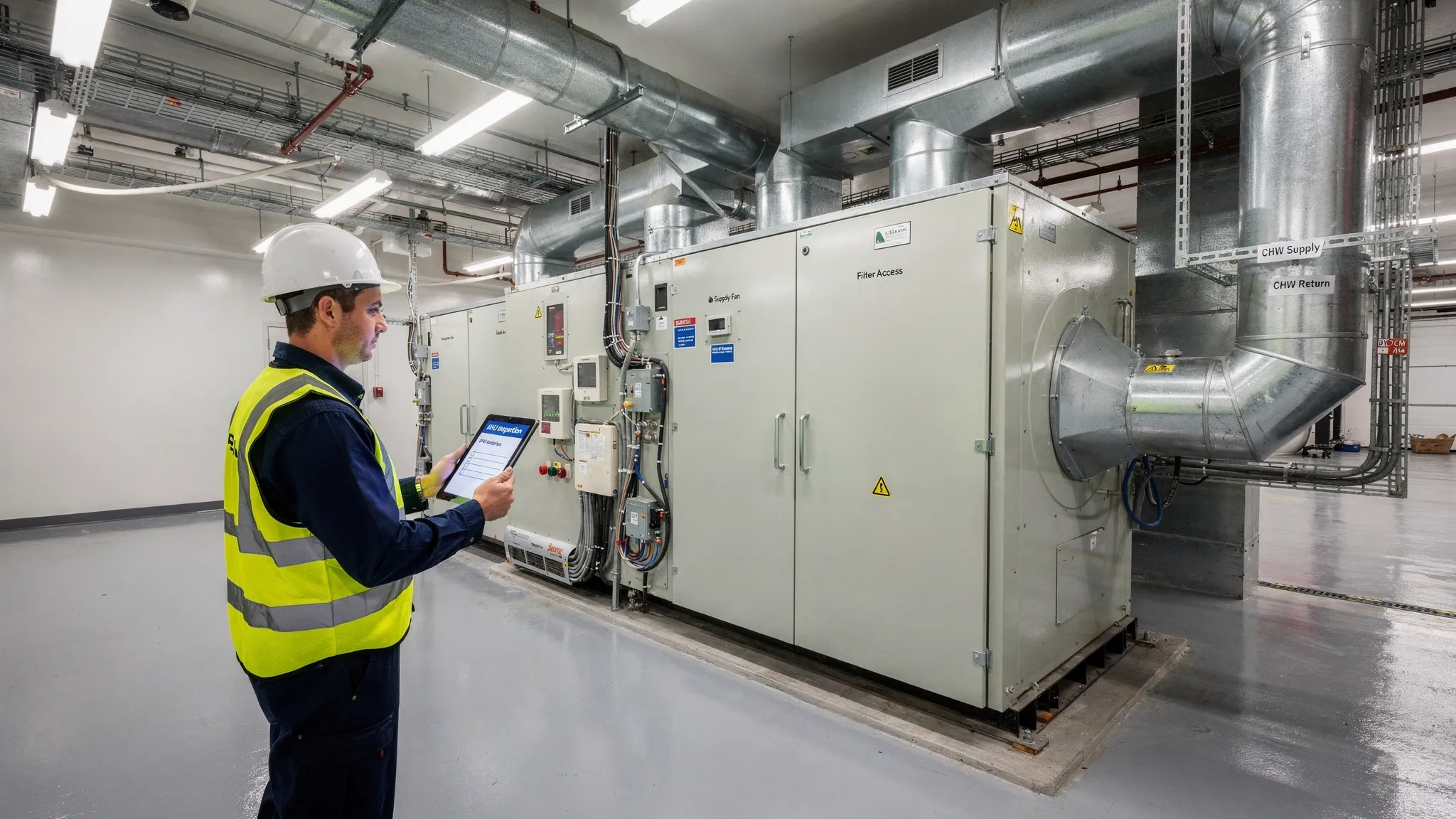
If you are wondering what is AHU in HVAC, think of it as the central machine that moves and conditions air so people can breathe and work comfortably inside a building. In simple terms, what is AHU in HVAC can be answered as a large unit that filters air, adjusts temperature and humidity then supplies that air through ducts.
In large buildings like offices, hospitals, malls and hotels, an AHU is not a nice-to-have. It is the backbone of indoor comfort and indoor air quality. This article explains what is AHU in HVAC from a practical building-owner perspective, why it matters more as buildings get bigger and what to look for in design, operation and maintenance.
If you are planning a new project or upgrading an existing system in Chennai, working with an experienced partner like Techno Power Aircons helps you match the right equipment with the right installation and long-term service.
AHU in HVAC: Meaning and role in large buildings
What an AHU does (in plain language)
To understand what is AHU in HVAC, focus on its job rather than the metal box itself. An AHU takes air from outside and from inside the building, cleans it using filters, cools or heats it using coils and pushes it into ducts that deliver air to rooms.
In many commercial projects, AHUs work alongside systems like VRF or VRV. If you are exploring centralised solutions, the overview page on VRF, VRV, AHU Air Conditioners in Chennai is a useful starting point for understanding where AHU-based distribution fits.
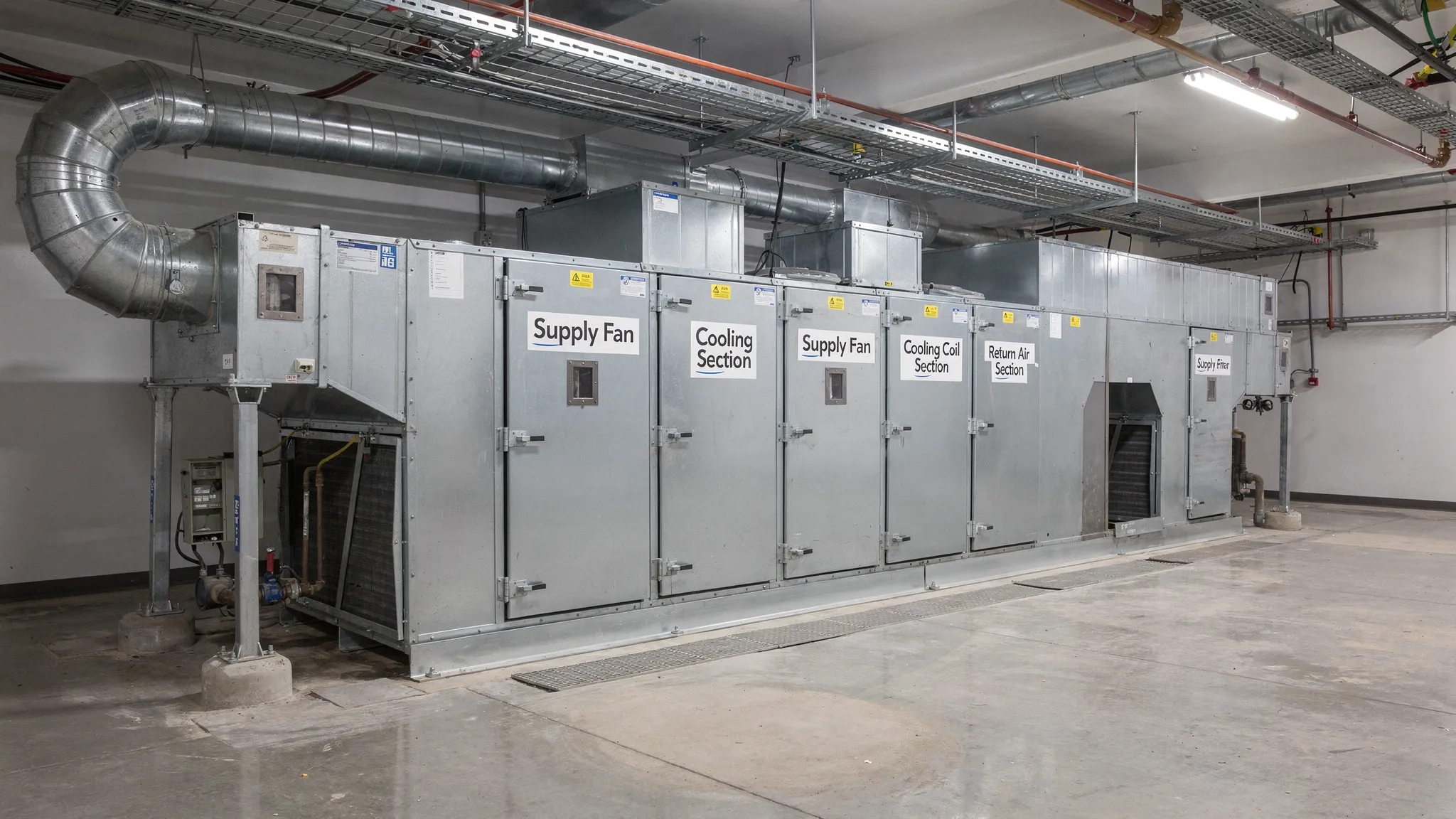
Key components inside an AHU
A good way to answer what is AHU in HVAC is to break it into sections. Most AHUs include the same core building blocks, even if size and features vary.
| AHU section | What it does | Why it matters in large buildings |
|---|---|---|
| Mixing box and dampers | Mixes return air with fresh outdoor air | Controls ventilation rates and helps reduce energy waste |
| Filters | Traps dust and pollutants | Protects occupants and also protects coils and fans |
| Cooling or heating coil | Cools or heats the air | Supports comfort, humidity control and stable temperatures |
| Supply fan (often with VFD) | Pushes conditioned air into ductwork | Enables airflow control across multiple floors and zones |
| Drain pan and condensate line | Removes condensed water | Prevents leaks, odour and microbial growth |
| Controls and sensors | Measures temperature, humidity, pressure | Helps optimise performance and spot issues early |
If you want a deeper installation-focused explanation for projects in Chennai, see this guide on the AHU AC System.
Why AHU matters more in large buildings
When people ask what is AHU in HVAC for a high-rise or campus, the bigger question is usually about control and consistency. Large buildings have long duct runs, varied heat loads and different occupancy patterns throughout the day.
An AHU supports:
- Consistent airflow across many spaces, not just one room
- Better filtration because air is treated in a central point
- Humidity management, which is crucial in coastal climates like Chennai
- Fresh air delivery that supports health and comfort
AHU and energy efficiency: where big savings come from
Many owners learn what is AHU in HVAC only after they see energy bills rise. The AHU is one of the best places to improve efficiency because it influences both fan power and cooling load.
Common efficiency levers include:
- Variable Frequency Drives (VFDs) on supply fans to match airflow to real demand
- Demand-controlled ventilation (using CO2 sensors) to avoid over-ventilating empty areas
- Better filtration selection that balances IAQ with pressure drop
- Proper chilled water temperature and coil selection
When AHUs are paired with modern VRF or VRV outdoor units, you can achieve tighter zone comfort with reduced part-load energy use. If your project is exploring this route, you can speak with experienced VRF AC dealers who understand both equipment selection and site execution.
Where AHUs are commonly used in real projects
To make what is AHU in HVAC practical, here are typical large-building applications where AHUs are selected because smaller room units are not enough:
- IT offices and co-working floors that need steady fresh air
- Hospitals and clinics that demand higher filtration and stricter airflow control
- Hotels and banquet halls with fast-changing occupancy
- Shopping malls with long operating hours and mixed tenant loads
- Industrial and clean areas where dust control matters
In several of these cases, AHUs feed duct networks across zones. For comparison, ducted comfort systems are also widely used for specific areas. This page on Ductable air conditioner explains where ducted systems fit well, especially when you need concealed cooling with uniform distribution.
AHU vs split AC: understanding the difference
A common confusion while learning what is AHU in HVAC is thinking it is just a bigger indoor unit. An AHU is designed for central air distribution and ventilation, while split ACs are typically room-focused comfort units.
Split systems can still be ideal in many smaller applications like apartments, cabins or small retail spaces. If you are evaluating that route for smaller zones within a larger property, explore Split Air conditioners to understand sizing, placement and suitability.
In short, split ACs usually prioritise cooling a room, while AHUs prioritise moving and treating large volumes of air for multiple spaces.
Maintenance tips that protect AHU performance
Once you understand what is AHU in HVAC, the next step is keeping it performing year after year. Poor maintenance often shows up as higher power bills, low airflow complaints and indoor air quality issues.
Practical AHU care for facility teams:
- Check filters on a schedule suited to dust levels and occupancy, replace before they clog
- Inspect drain pans and condensate lines to prevent leakage and odour
- Clean coils periodically because dirty coils reduce cooling and increase energy use
- Verify belt tension and bearing condition if the AHU uses belt-driven fans
- Confirm damper operation so fresh air and return air mixing stays correct
For many commercial buildings, an annual maintenance contract reduces downtime risk, especially before peak summer. You can consider an amc for air conditioner that covers preventive visits, performance checks and priority support.
Latest AHU trends in 2026 (what building owners should know)
If you are revisiting what is AHU in HVAC in 2026, you will notice that the conversation is no longer only about cooling. It is about health, controls and lifecycle cost.
Key trends shaping AHU selections:
- Indoor air quality upgrades: better filter banks and tighter cabinet sealing to reduce bypass air
- Smart monitoring: sensors for static pressure, filter differential pressure and vibration to catch problems early
- Energy recovery: heat recovery wheels or plate heat exchangers to pre-condition outdoor air in large fresh-air loads
- Predictive maintenance: using BMS trends to plan service before breakdowns
To implement these trends properly, the system still needs basics done right: correct duct design, proper commissioning and reliable after-sales support.
Choosing the right AHU for a large building
A final way to think about what is AHU in HVAC is to treat it as a customised air plant, not a standard box. Selection depends on building usage, ventilation needs, heat load and operating hours.
Before you finalise an AHU, confirm:
- Airflow requirement (CFM) based on load calculations and ventilation targets
- Filtration level based on occupant needs and dust conditions
- Humidity control strategy for monsoon and coastal months
- Service access space for filter replacement and coil cleaning
- Controls integration with a Building Management System where applicable
For projects in Chennai, Techno Power Aircons has long experience in sales, installation and after-sales support since 1982, which matters because AHU performance depends heavily on correct installation and ongoing service, not only on the brand name.
Conclusion: why AHU knowledge matters for building performance
Understanding what is AHU in HVAC helps you make better decisions about comfort, indoor air quality and operating cost, especially in large buildings where ventilation and airflow control are non-negotiable. A well-selected AHU with proper controls and disciplined maintenance can reduce complaints, improve productivity and support healthier indoor environments.
If you are planning an AHU-based solution or upgrading an existing HVAC system in Chennai, connect with Techno Power Aircons for guidance on selection, installation and long-term service. Reach out through the contact us page to discuss your building requirements.
Frequently Asked Questions
What is the full form of AHU in HVAC?
AHU stands for Air Handling Unit. It is a unit that filters, cools or heats and circulates air through ducts.
What is the main purpose of an AHU in large buildings?
The main purpose is to supply clean, conditioned air at the required airflow to multiple zones while also supporting ventilation and humidity control.
Is an AHU the same as a split AC indoor unit?
No. A split AC indoor unit is typically designed for a single room or zone. An AHU is designed to handle larger airflow, ventilation and duct distribution for multiple areas.
How often should AHU filters be replaced?
It depends on dust levels, occupancy and filter type. Many sites inspect monthly and replace when pressure drop rises or when filters appear clogged.
Do AHUs work with VRF or VRV systems?
Yes. In many commercial designs, AHUs can be paired with VRF or VRV systems using suitable coils and controls to meet ventilation and comfort requirements.
Leave a Reply