
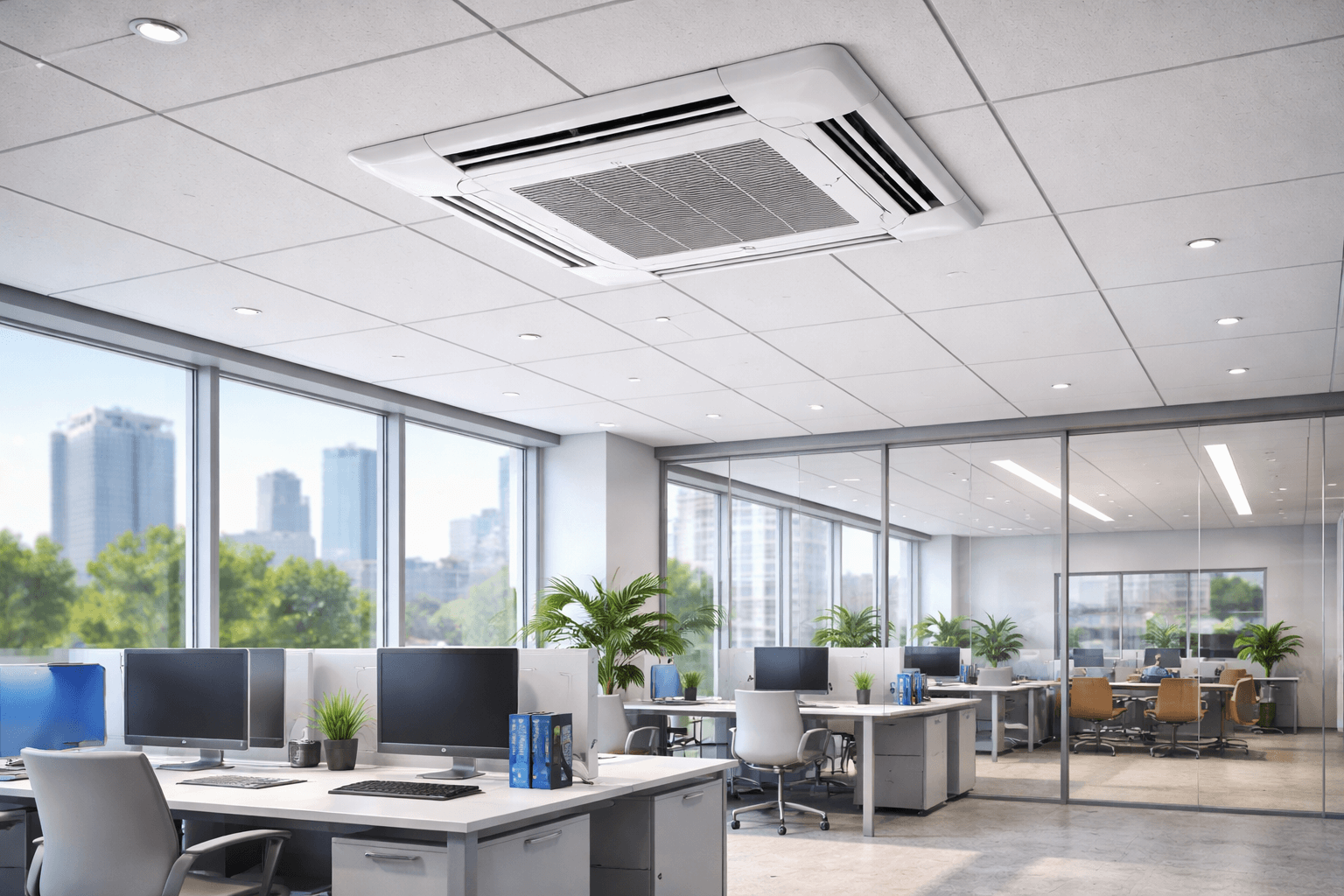
Commercial buildings today demand more than just cooling. They need intelligent climate control systems that can handle long operating hours, varying occupancy levels, and rising energy standards. That’s where VRV Daikin AC systems come into the picture..
VRV, which stands for Variable Refrigerant Volume, is a technology developed by Daikin. The idea is simple but powerful. One outdoor unit connects to multiple indoor units, and the system adjusts refrigerant flow in real time depending on how much cooling each zone actually needs. In plain terms, a VRV air conditioner cools only where required and only to the extent required. No unnecessary overcooling. No wasted energy.
For commercial projects in Chennai, working with experienced professionals like Techno Power Aircons makes a noticeable difference. From system planning to installation and post-installation support, the right guidance ensures the VRV system performs exactly as intended.
Why Commercial Projects Lean Toward VRV Daikin AC
1. Energy Efficiency That’s Actually Noticeable
One of the biggest reasons builders and facility managers consider a VRV Daikin AC system is energy efficiency.
Traditional AC systems tend to run at fixed capacity. They switch on, hit full power, switch off, and repeat. That constant cycling eats power and creates temperature swings. You feel it.
VRV systems use inverter-driven compressors. Instead of constantly stopping and starting, they adjust speed gradually. Cooling output matches the real demand.
In practical terms, this usually means:
- Less energy wastage
- More stable room temperatures
- Reduced wear and tear on components
- Better long-term performance
In offices, hospitals, hotels, and retail outlets, where usage changes hour by hour, variable control really adds up over time.
2. Zoning That Makes Real-World Sense
Commercial buildings are rarely uniform. One floor might be packed with people, another half-empty. A conference room might need strong cooling for two hours, then sit unused the rest of the day.
With a VRV Daikin AC system, each zone can be controlled separately.
That means:
- Individual temperature control for rooms or sections
- Simultaneous cooling in multiple zones
- Flexibility if layouts change later
For example, in an office, cabins, open workstations, and meeting rooms all behave differently in terms of heat load. A VRV air conditioner handles those variations without overcooling one side just to satisfy another.
3. Design Flexibility (Architects Appreciate This)
Modern buildings aren’t simple rectangular boxes anymore. Glass façades, irregular layouts, split floors they look great, but they complicate HVAC design.
VRV systems help because they support:
- Long piping lengths
- Compact outdoor units
- Multiple indoor unit types (cassette, ducted, wall-mounted, etc.)
- Phased installation for expanding projects
Compared to bulky centralized systems, a VRV Daikin AC setup is often easier to integrate without compromising design aesthetics.
4. Quieter Operation (Underrated Benefit)
Noise matters more than people think.
Offices need focus. Hospitals need silence. Retail spaces need comfort without mechanical distractions. VRV air conditioners run more smoothly because compressors ramp up and down gradually instead of jolting on and off.
You don’t always notice it immediately, but over time, the quieter environment makes a difference.
How VRV Installation Typically Works
Here’s the part that can’t be ignored: even the best system underperforms if installation is sloppy.
Step 1: Site Evaluation & Load Calculation
Before anything is installed, engineers evaluate:
- Total area
- Occupancy patterns
- Heat from lightning and equipment
- Sun exposure and orientation
Accurate load calculation is crucial. Oversizing wastes money. Undersizing creates discomfort. Both are common mistakes when shortcuts are taken.
Step 2: System Design & Planning
After the assessment, the complete layout is designed:
- Outdoor unit placement
- Indoor unit selection
- Refrigerant piping routes
- Drainage and electrical planning
This stage is where experience really shows. Poor planning leads to rework later.
Step 3: Installation & Piping
Outdoor units are mounted in ventilated areas. Indoor units are installed based on the layout plan. Refrigerant lines are connected and insulated properly (this is important, as bad insulation leads to efficiency loss and condensation problems).
Everything is done as per manufacturer guidelines.
Step 4: Testing & Commissioning
Before handover, the system is tested for:
- Correct refrigerant charge
- Electrical safety
- Zoning functionality
- Stable temperature performance
Commissioning ensures the VRV Daikin AC system operates the way it was designed to.
VRV vs Other AC Systems
VRV vs Split AC Systems
Split ACs are fine for small shops or individual rooms. But in large commercial spaces, you end up with too many outdoor units, messy piping, and complicated maintenance.
A VRV air conditioner connects multiple indoor units to fewer outdoor units. Cleaner setup. More efficient management.
VRV vs Chiller Systems
Chillers are common in very large commercial complexes. But they require significant mechanical space and complex ducting.
VRV systems offer:
- Better zoning flexibility
- Less space requirement
- Modular expansion options
- Easier integration for medium to large projects
Chillers still make sense for certain mega-scale applications, but for many commercial buildings, VRV Daikin AC systems offer a more adaptable solution.
Choosing the Right VRV AC Dealer in Chennai
This part is often underestimated.
Even the best equipment won’t deliver expected results without proper design and execution.
When selecting a dealer:
Look for Experience
Commercial HVAC isn’t the same as residential AC installation. Choose a company that understands load calculations, zoning logic, and long-term maintenance planning.
Check Technical Capability
Are their technicians trained in VRV systems? Are they familiar with diagnostics and commissioning procedures? These details matter more than branding claims.
After-Sales Support
Long-term reliability depends on service quality. Look for:
- Preventive maintenance plans
- Quick response support
- Access to genuine spare parts
If your building runs year-round, service reliability isn’t optional.
Companies like Techno Power Aircons in Chennai, for example, focus specifically on commercial HVAC execution and long-term support. Working with a technically sound team reduces risks during both installation and operation.
Final Thoughts
Choosing an HVAC system for a commercial project isn’t just about cooling capacity. It’s about long-term operating cost, flexibility, maintenance, and how well the system adapts to real-world usage.
A VRV Daikin AC system offers:
- Intelligent energy control
- Flexible zoning
- Design adaptability
- Quieter operation
- Modular scalability
But technology alone isn’t enough. Proper design, installation, and ongoing maintenance are just as important.
Contact Techno Power Aircons today to get a detailed site evaluation, accurate load calculation, and a VRV solution designed specifically for your building’s needs.
Frequently Asked Questions about VRV Daikin AC
What exactly is a VRV Daikin AC system?
It’s a Variable Refrigerant Volume system developed by Daikin that connects multiple indoor units to a single outdoor unit, adjusting refrigerant flow based on demand.
How is it different from a regular AC?
Traditional systems operate at fixed capacity. VRV systems adjust output continuously, making them more efficient for larger, variable-load environments.
Is it suitable for smaller commercial spaces?
Yes. VRV systems are modular and scalable. They can work in smaller offices as well as large complexes.
Does it really improve energy efficiency?
In most commercial environments with fluctuating occupancy, yes. The modulation of compressor speed reduces unnecessary power consumption.
Can it support expansion later?
Often, yes, provided initial capacity planning allows for it.
Leave a Reply