
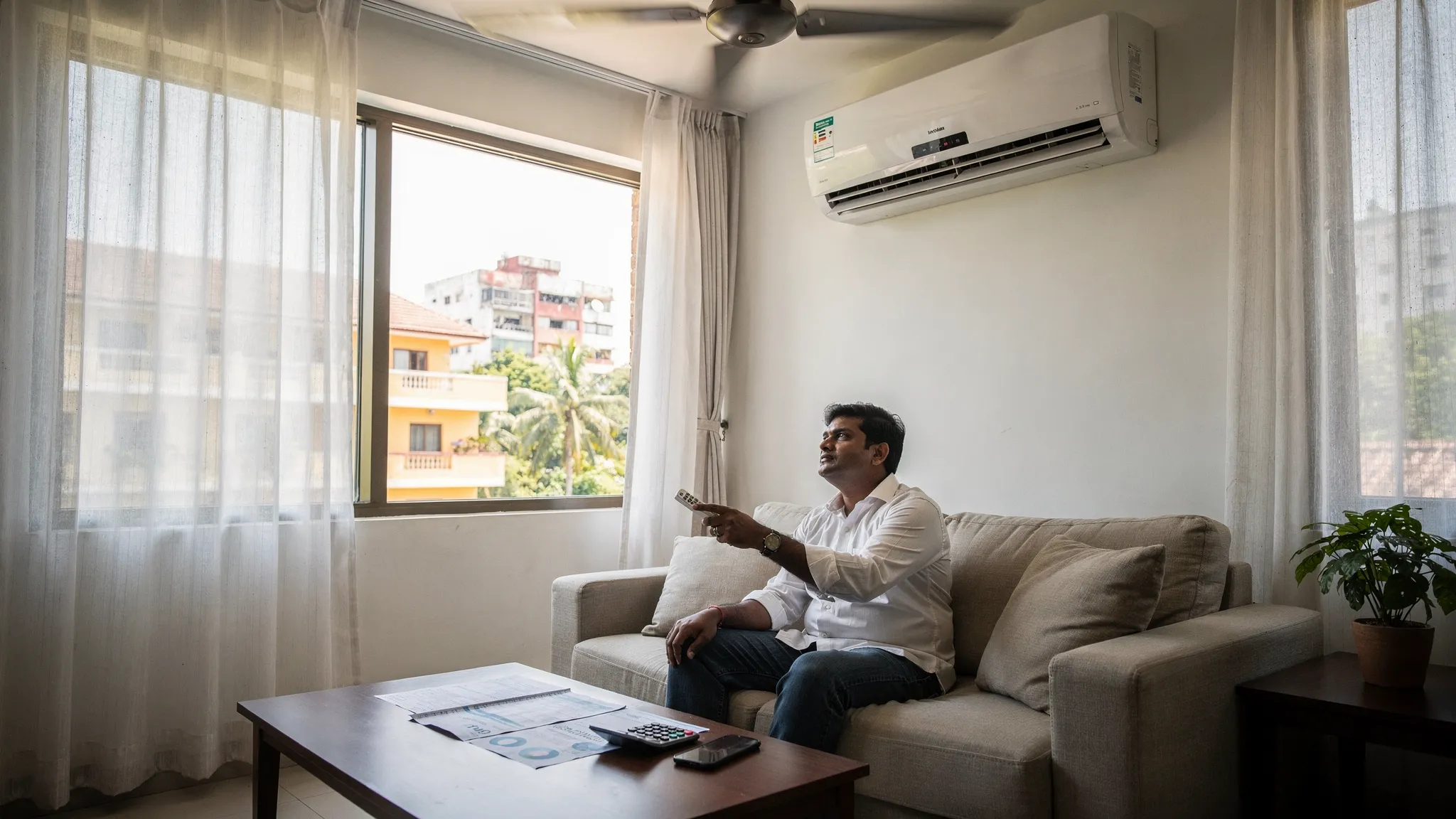
Keeping cool in Chennai is non‑negotiable, but nobody wants bill shock. So understanding the Aircon power usage is very important to avoid such situations. This practical guide shows you how to pick the right AC tonnage for your room and reduce the electricity usage. You will also find simple tips to cut power usage without sacrificing comfort.
Pick the Right AC Tonnage for Your Room
Choosing correct capacity avoids two costly mistakes. Under sizing makes the AC run harder and longer, oversizing causes short cycling that wastes energy and leaves air humid.
Quick room‑size to tonnage guide for Chennai
Use this as a starting point, then adjust for sun exposure, insulation, occupancy and floor level.
| Room size (sq ft) | Typical AC size | Go higher if | Go lower if |
|---|---|---|---|
| 90 to 110 | 1.0 ton | West facing, top floor, many gadgets | Well shaded, low sun, excellent insulation |
| 111 to 150 | 1.0 to 1.2 ton | Large windows, 3 to 4 people often | Shaded, 2 people, false ceiling insulation |
| 151 to 200 | 1.5 ton | Open kitchen nearby, top floor, heavy sun | Minimal sun, fewer occupants, good insulation |
| 201 to 260 | 2.0 ton | High ceilings above 10 ft, glass walls | Highly insulated, mostly evening use |
If you are comparing brands for a new purchase aiming to reduce the aircon power usage, the best AC dealer in Chennai can help you to shortlist option from the best AC brand for Chennai heat.
Convert Capacity to Power Usage
Two numbers on the label tell you how much electricity an AC is likely to use.
- Cooling capacity, shown as tons, BTU per hour or kW. 1 ton equals 12,000 BTU per hour, which is 3.517 kW of cooling.
- Efficiency rating, ISEER or EER. Higher is better. In India, the BEE star label shows ISEER and an indicative annual electricity consumption.
Inverter ACs throttle down after reaching set temperature, so real‑world average power is usually 50 to 70 percent of the rated input depending on setpoint, insulation and usage.
How to Read the BEE Label and Nameplate Correctly
- Check ISEER and the star rating. Higher ISEER means lower electricity for the same cooling.
- Look for Annual Energy Consumption on the label. This is a standardized estimate for typical usage. Use it as a benchmark between models.
- On the indoor or outdoor unit nameplate, note the rated power input in watts. This is your quickest number for cost maths if ISEER is not available.
7 Proven Ways to Cut Your Aircon Power Usage
- Set at 24 to 26°C, not 18 to 20°C. The Ministry of Power recommends 24°C as a default setpoint for efficiency. Even a 1°C higher setting can save meaningful units over a month.
- Use Dry mode on very humid days when you need dehumidification more than rapid cooling.
- Clean filters every 2 to 4 weeks during peak season. Clogged filters can add 5 to 15 percent to power draw.
- Shade the outdoor unit and keep coils clean. Poor airflow and dirty coils force higher compressor load.
- Seal gaps around doors and windows, use curtains or reflective blinds in west‑facing rooms.
- Pair the AC with a ceiling fan at low speed. You can raise the setpoint by 1 to 2°C and feel the same comfort.
- Service the AC before summer. A preventive check catches low refrigerant, failing capacitors and blocked drains. If you prefer worry‑free upkeep, consider an AC AMC in Chennai.

Multi‑Room or Office? Consider VRF for Lower Lifecycle Costs
If you are cooling several rooms or floors, a properly designed VRF or VRV system can match load precisely across zones, which reduces wastage, improves humidity control and often lowers long‑term energy costs compared to multiple standalone units. Explore options with a VRF and VRV AC dealer in Chennai.
When Capacity is Wrong, Bills Suffer
- Too small, the AC runs flat out, takes longer to dehumidify and may never reach setpoint on very hot days.
- Too large, the AC short cycles, air stays clammy and inverter benefits are reduced because the compressor does not get enough steady run time at efficient part load.
If you are unsure, ask for a quick heat‑load assessment. Techno Power Aircons, the best AC dealer in Chennai has been advising homes and offices in Chennai since 1982 and can size, install and maintain systems across leading brands. If you are price‑shopping, you can also check for Low price AC in Chennai.
Get a Right‑Sized AC and a Predictable Bill
If you want a no‑guesswork sizing and running‑cost estimate tailored to your home or office anywhere in Chennai, talk to Techno Power Aircons in Chennai. Since 1982 we have helped customers choose the correct tonnage, install it properly and keep it efficient with dependable after‑sales support and AMC options. We carry leading brands and advanced systems including VRF and VRV.
Contact us now to ask about current trends, offers and seasonal discounts. When your AC is sized right and installed right, comfort is high and electricity costs stay under control.
Frequently Asked Questions
How many units does a 1.5 ton AC consume per hour? At rated conditions, a 1.5 ton 3‑star unit might draw about 1.4 to 1.5 kW and a 5‑star unit around 1.1 kW. Multiply by your tariff to get cost per hour. In real use, an inverter often averages 50 to 70 percent of its rated draw once the room reaches setpoint.
What is ISEER and why does it matter? ISEER is the Indian Seasonal Energy Efficiency Ratio. It measures cooling output over a season divided by energy input over that season. Higher ISEER means lower electricity for the same cooling. It is displayed on the BEE star label.
Do inverter ACs always save money? Yes when correctly sized and used at sensible setpoints. They run the compressor at variable speeds to match load, which avoids wasteful on‑off cycles. Savings fall if the unit is oversized or if you routinely set very low temperatures.
Does setting 24°C really reduce bills compared to 20°C? Yes. Each degree higher reduces compressor workload, so units consumed drop over time. The Ministry of Power has recommended 24°C as a default for energy efficiency.
Is a stabilizer required in Chennai? Many modern inverter ACs work across a wide voltage band. If your area has frequent low or high voltage events, a branded stabilizer with the right kVA rating protects electronics and can prevent expensive failures.
How do I get an accurate running‑cost estimate for my home? Note your room sizes, usage hours, preferred setpoint and tariff slab, then share the AC model’s ISEER or rated input with a dealer. A quick load check plus your star label data gives a precise monthly estimate.
Leave a Reply