
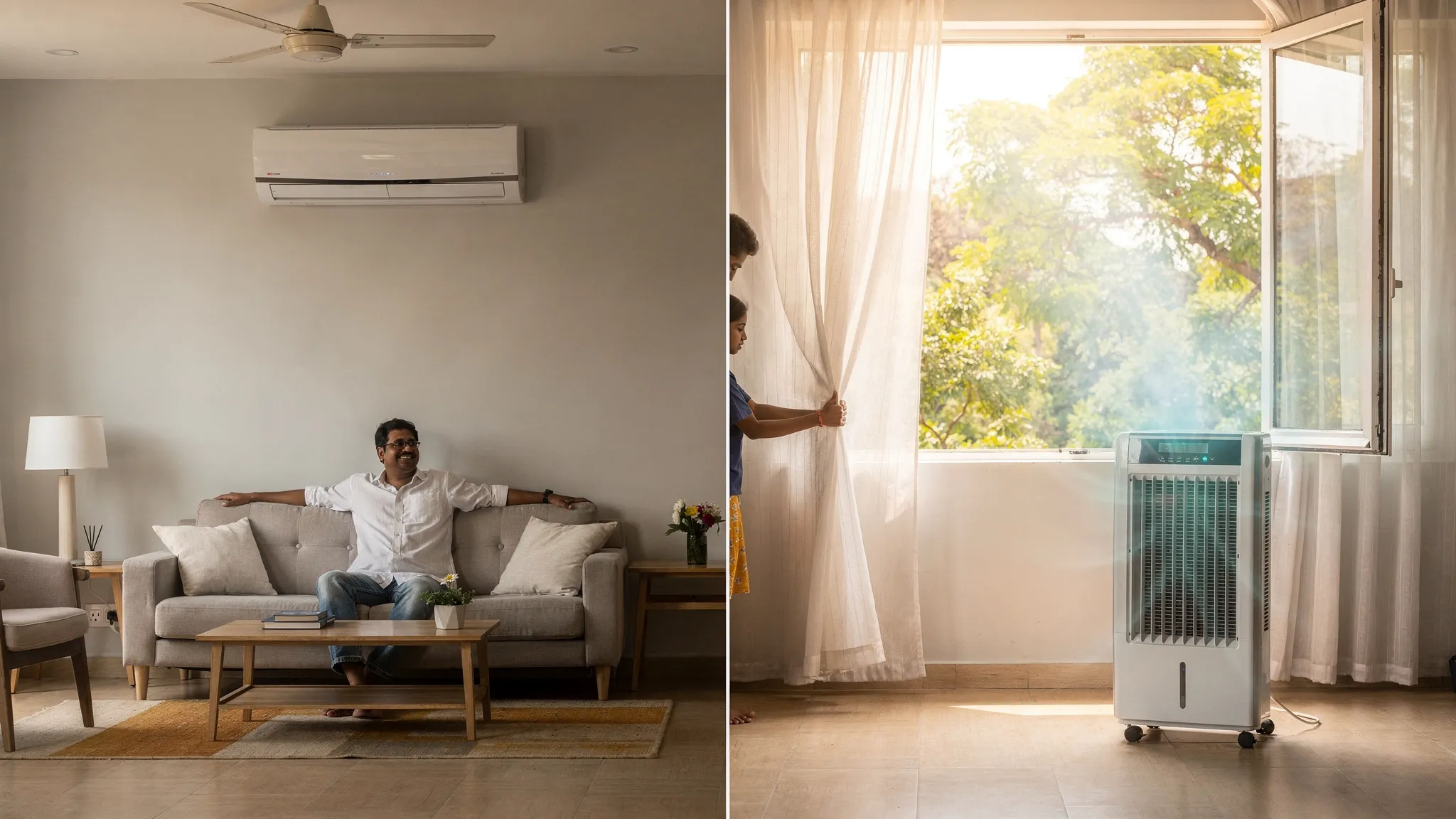
Choosing between an air cooling unit (commonly an evaporative air cooler) and an air conditioner can feel confusing because both “blow cool air”, but they work in completely different ways. The right choice depends on your room size, ventilation, Chennai’s humidity, electricity and water availability, and the comfort level you expect.
This guide breaks down the key differences so you can decide with confidence for your home, shop, or office.
What is an air cooling unit (air cooler)?
An air cooling unit typically refers to an evaporative cooler. It uses a fan to pull warm air through wet cooling pads. As water evaporates, it absorbs heat from the air, so the air leaving the cooler feels cooler.
Because this method depends on evaporation, the cooling effect is strongest in hot, dry conditions and weaker in humid coastal climates.
What is an air conditioner?
An air conditioner cools using a refrigeration cycle (compressor, refrigerant, coils). It removes heat from indoor air and releases it outdoors. Importantly, most ACs also remove moisture (dehumidify) as part of the process.
If you are comparing options for bedrooms, living rooms, cabins, clinics, or any space where you want stable temperature and humidity, ACs are designed for that.
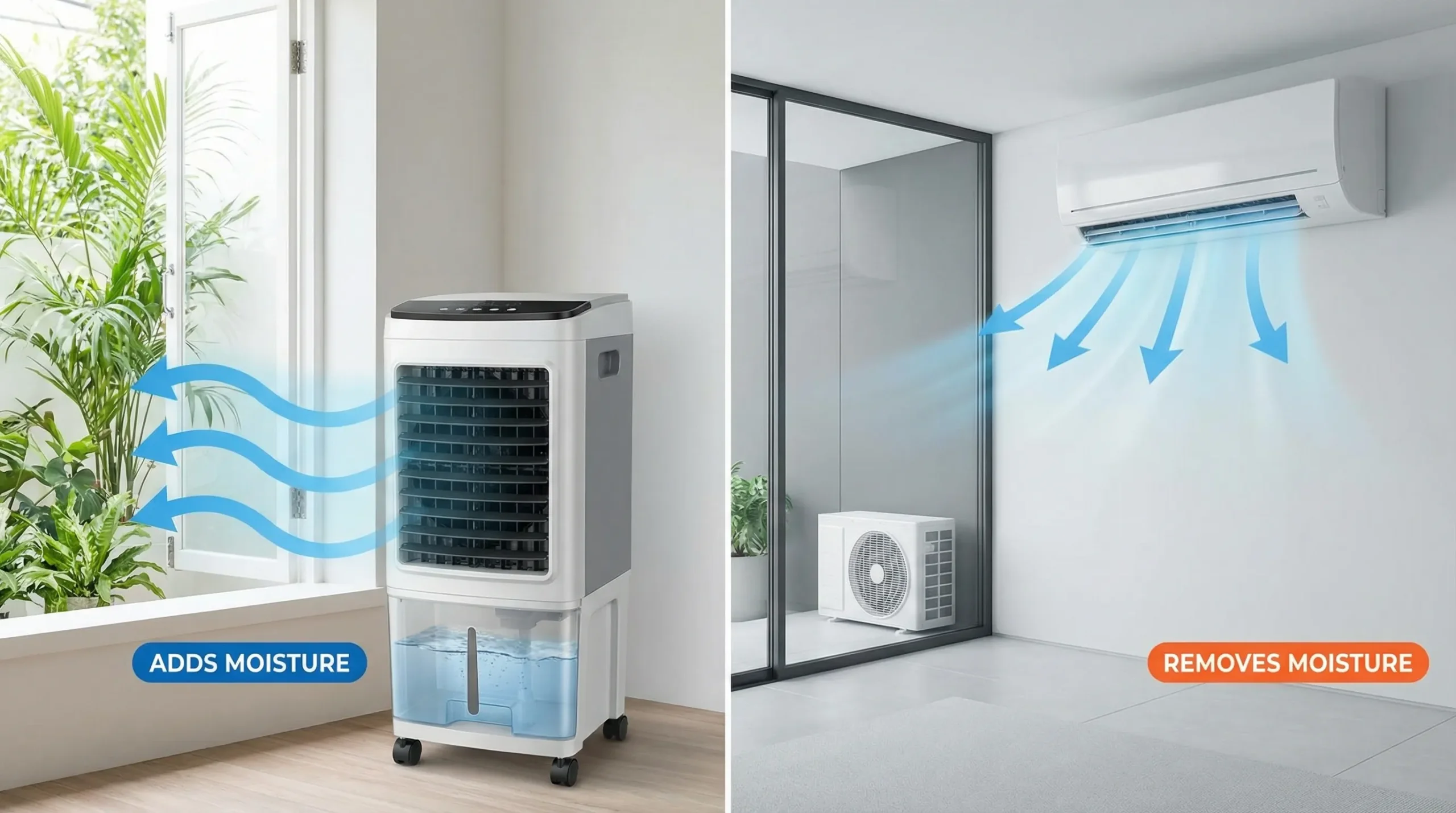
Air cooling unit vs air conditioner: the core difference (in one line)
- Air cooling unit: cools by evaporating water, needs airflow/ventilation, adds humidity.
- Air conditioner: cools by refrigeration, works best in closed rooms, removes humidity.
Key differences that matter in real life
1) Cooling performance and comfort
An air cooler can make air feel cooler, but it usually cannot “set and hold” a precise room temperature the way an AC can. ACs are built to reach a target temperature and maintain it with thermostat control.
In Chennai, comfort is not only about temperature, it is also about humidity. ACs typically feel more comfortable because they reduce stickiness by lowering indoor moisture.
2) Humidity: the biggest deciding factor in coastal Chennai
Evaporative coolers add moisture to the air. When outside humidity is already high (common in Chennai, especially evenings and monsoon months), evaporation slows down and the cooler’s effectiveness drops.
ACs do the opposite, they remove moisture during cooling, which is often why the room feels comfortable even at moderate temperature settings.
If you want an efficiency benchmark while shopping for ACs, India’s BEE Star Label program is a reliable reference point for comparing models on energy efficiency metrics (like ISEER). See the Bureau of Energy Efficiency (BEE) for official guidance and labels.
3) Ventilation requirements
This is a practical difference many buyers miss.
Air cooling unit: needs a path for fresh air to enter and for warm, humid air to exit.
- Works best with open windows/doors or an exhaust.
- Best for semi-open spaces, halls with cross-ventilation, workshops.
Air conditioner: performs best in a more sealed room.
- Doors/windows closed helps it cool faster and consume less power.
- Better for bedrooms, cabins, conference rooms.
4) Electricity consumption (typical trend)
While exact consumption depends on size and model, the general pattern is:
- Air coolers often use a few hundred watts (fan + small pump).
- Air conditioners commonly draw 1 kW or more while running (compressor load varies with capacity, inverter control, and heat load).
That is why air coolers are often marketed as “low power”, but note the trade-off: lower power use does not always mean better comfort in humid weather.
5) Water usage and maintenance hygiene
Air coolers consume water and require regular cleaning.
If you use an air cooler, plan for:
- Frequent water refills (or a water line connection)
- Cleaning the tank to avoid odour and slime
- Replacing/cleaning cooling pads
- Preventing mosquito breeding if water stagnates
ACs do not consume water, but they generate condensate that drains out. They still need maintenance (filters, coils, drain line), just of a different type.
6) Air quality and filtration
- Air cooling unit: brings in more outside air (good for ventilation), but can also bring in more dust unless there is a good filter and clean pads.
- Air conditioner: recirculates indoor air and filters it. Filtration quality varies by model, but in general it helps reduce indoor dust when filters are maintained.
For households with allergies or for clinics and offices, consistent filtration and humidity control often favour ACs.
7) Installation, space, and noise
- Air coolers: usually minimal installation, portable options exist. Noise depends on fan size.
- ACs: require professional installation, outdoor unit placement, proper piping, electrical readiness, and drainage planning. Noise is typically lower indoors for split ACs, with compressor noise outside.
For complex buildings or multi-zone needs, AC technologies like VRF/VRV can provide scalable cooling with zone control. (If you are evaluating those systems, see Techno Power Aircons’ overview of VRF/VRV air conditioners.)
Side-by-side comparison table
| Factor | Air Cooling Unit (Evaporative Cooler) | Air Conditioner |
|---|---|---|
| Cooling method | Evaporates water through wet pads | Refrigeration cycle using compressor + refrigerant |
| Best climate | Hot and dry | Hot and humid, hot and dry, most climates |
| Humidity effect | Increases humidity | Reduces humidity (dehumidifies) |
| Room requirement | Needs ventilation (fresh air in, warm air out) | Works best in closed rooms |
| Temperature control | Limited, comfort varies by weather | Strong, thermostat-based control |
| Electricity use | Lower (typically a few hundred watts) | Higher (often 1 kW+) depending on tonnage and load |
| Water requirement | Yes | No |
| Maintenance focus | Tank hygiene, pad cleaning/replacement | Filter cleaning, coil cleaning, drain line, professional service |
| Typical use cases | Workshops, semi-open spaces, budget cooling | Bedrooms, living rooms, offices, clinics, retail |
Which one should you choose in Chennai?
Chennai’s weather is often hot and humid, which usually pushes the decision toward an air conditioner for consistent comfort.
Choose an air cooling unit if:
You are okay with “relief cooling” rather than precise temperature control, and you have good ventilation.
Common good-fit scenarios:
- You want low initial spend and lower electricity draw
- The space is airy, semi-open, or you can keep windows open
- Short-duration cooling (daytime use, non-sleeping areas)
Choose an air conditioner if:
You want dependable comfort, especially during humid months, and you need controlled indoor conditions.
Common good-fit scenarios:
- Bedrooms and night-time comfort (humidity control matters)
- Offices, cabins, clinics, and meeting rooms
- Homes near the coast where humidity stays high
If you are buying for a home and want a mainstream, service-friendly option, split ACs are the most common starting point. You can explore Techno Power Aircons’ split AC dealer page for the categories and support you should expect from a dealer.
A practical “quick check” before you decide
Instead of guessing, consider these three questions:
1) Is your room usually closed (bedroom/office) or open (hall/workshop)?
Closed rooms tend to suit ACs. Open, well-ventilated spaces can suit coolers.
2) Do you feel sticky even after a fan is running?
That is a humidity problem. ACs address it directly.
3) Do you have a safe plan for water and hygiene (for a cooler)?
If regular cleaning is unlikely, an air cooler can become uncomfortable due to odour and air quality issues.
Cost ownership: don’t look only at purchase price
Many buyers compare only upfront price, but comfort systems are long-term assets.
- A cooler may be cheaper upfront, but can be less effective when humidity rises.
- An AC costs more, but delivers predictable comfort, and with correct sizing and regular maintenance it can run efficiently.
Regular servicing matters for both. For ACs, preventive maintenance helps maintain cooling performance and reduces breakdown risk. If you want structured upkeep, consider an Annual Maintenance Contract and professional servicing support like Techno Power Aircons’ AC AMC in Chennai information.
When it’s worth upgrading to advanced AC systems
If your requirement goes beyond a single room, for example multiple cabins, a duplex home, a clinic with many zones, or a mid-size office floor, it may be worth evaluating:
- Multi-split configurations
- Ductable systems
- VRF/VRV systems for scalable zoning and better part-load efficiency
These require correct heat-load estimation, installation planning, and long-term service readiness. A dealer with strong after-sales support becomes as important as the brand.
Getting the choice right (and avoiding common mistakes)
The most common mistake is buying based on “tonnage” or “airflow” alone.
For better results:
- Match the solution to Chennai humidity and your ventilation reality
- Prioritise energy-efficiency ratings when selecting AC models (BEE labels help)
- Plan maintenance from day one, especially drain cleaning and filter care for ACs, and tank/pad hygiene for coolers
If you want help choosing the right cooling solution for your space in Chennai, Techno Power Aircons can guide you across residential and commercial options, including sales, installation, and after-sales support (with expertise since 1982).
Leave a Reply