

Indian summers are getting hotter and longer and the air conditioner market is evolving quickly to keep up. If you plan to buy or upgrade your AC, a little market intelligence will help you choose a system that saves electricity, handles humidity and lasts longer in Indian conditions especially in coastal cities like Chennai.
This blog distills the biggest trends at present shaping how Indians buy, run and maintain ACs, plus practical takeaways you can use at a showroom or when speaking with a dealer.
The Big Picture Ahead
- Inverter-first is now the default for most residential buyers, thanks to lower energy bills and quieter operation.
- Seasonal efficiency matters more than ever. BEE Star Labels and ISEER remain the simplest way to compare models across brands.
- Refrigerants are shifting to align with India’s Kigali Amendment commitments, with R32 now common in room ACs and wider discussion around lower-GWP options in the coming years.
- Smart ACs with Wi‑Fi app control, voice assistants, and energy monitoring are becoming standard at mid-range prices.
- Multi-zone systems, especially VRF or VRV are gaining traction in villas, apartments, offices and retail where different rooms need different temperatures.
- Coastal durability features, copper condensers and anti-corrosion coatings are key differentiators in cities like Chennai.
- Service quality and AMC plans are becoming decisive, because performance depends as much on installation and maintenance as on the sticker specs.
10 Trends Indian Buyers Should Know
1) Inverter-first buying
Inverter compressors adjust speed to the room’s actual cooling need. That means lower electricity use, fewer temperature swings and less noise. Now the gap between inverter and non-inverter prices continues to narrow, so total cost of ownership strongly favors inverter for most homes and offices.
What to ask: the ISEER rating, whether it uses a twin-rotary inverter compressor and warranty terms on compressor and PCB.
2) BEE ISEER and star labels drive decisions
BEE’s Star Label with ISEER remains the quickest way to compare seasonal performance in Indian climates. A higher ISEER usually means lower bills. Many buyers are moving to 5-star where usage is high, while 3 or 4-star can be smart for light usage or guest rooms.
What to ask: the ISEER value, typical power draw at part load and any energy-saver modes relevant to humid conditions.
3) Refrigerants shift to lower GWP
R32 has become common in room ACs because it delivers good efficiency with a lower global warming potential than older R410A. Commercial systems are also evolving and you will see more discussions about next‑gen lower‑GWP refrigerants in the coming years as India implements its Kigali phasedown steps.
What to ask: the refrigerant used, availability of service tools and spares and safety classifications followed during installation and maintenance.
4) Smart, connected and stabilizer-free operation
Wi‑Fi control, energy usage reports, geo-fencing and voice assistant compatibility are moving into mainstream models. Many ACs also offer stabilizer-free operation across a wide voltage range, valuable in areas with fluctuations.
What to ask: supported apps and voice ecosystems, offline controls if Wi‑Fi fails and voltage protection limits.
5) Humidity and indoor air quality features
Indian summers bring heat plus humidity, especially in Chennai. ACs that handle latent loads more efficiently, offer dehumidification modes, PM2.5 filtration and auto-cleaning coils reduce mold and maintain performance.
What to ask: dehumidification capacity, filter type and maintenance schedule and coil-cleaning features.
6) VRF and multi-zone cooling grow outside large offices
VRF or VRV systems let you condition multiple rooms at different set points from a compact outdoor unit. Now, more apartments, villas, clinics, salons and boutique offices are upgrading to VRF for better comfort and lower energy use compared to running multiple independent splits.
Learn why VRF Air Conditioning is Perfect for Chennai’s Climate and explore specialized VRF/VRV AC Dealer In Chennai.
7) Coastal durability as a must-have in Chennai
Salt-laden air corrodes outdoor coils and fins. Buyers are prioritizing copper condensers, blue-fin or similar anti-corrosion coatings, high-quality cabinets and service-friendly designs to extend service life near the coast.
What to ask: the type of condenser coil, corrosion protection used and maintenance frequency recommended for coastal zones.
8) Green building codes shape commercial choices
Evolving energy efficiency and sustainability practices are driving a shift toward higher ISEER performance, intelligent controls and VRF solutions for multi-zone spaces. For offices, schools, clinics or retail, this often tips the choice toward VRF or premium inverter splits with building control integration.
What to ask: compliance targets, control integrations and part-load efficiency.
9) Total cost of ownership beats lowest MRP
With electricity tariffs and longer usage hours, buyers are weighing energy savings, service access, spare parts availability and resale value. Premium efficiency usually pays back in a few seasons in high-usage homes and most commercial settings.
What to ask: a simple payback comparison between 3-star and 5-star options based on your usage pattern and the cost of common spares outside warranty.
10) Service quality, AMC and financing
Installation quality can change outcomes by 10 to 20 percent in real-world performance. Nowadays, more buyers lock in AMCs for predictable upkeep. Zero-cost EMIs and extended warranties reduce upfront stress, especially for VRF buyers and homeowners upgrading multiple rooms.
Consider a professionally managed AC AMC in Chennai and explore purchasing support from experienced local dealers.
Quick View: Current Trends and What to Do About Them
| Trend | Why it matters | Who benefits most | What to ask your dealer |
|---|---|---|---|
| Inverter-first market | Lower bills, quieter, better comfort | Most homes and SMEs | ISEER, compressor type, PCB warranty |
| Higher ISEER focus | Faster payback for heavy users | High-usage homes, offices | ISEER value, part-load efficiency |
| Lower-GWP refrigerants | Policy alignment, future-ready | Everyone | Refrigerant type, service readiness |
| Smart, connected control | Convenience, energy visibility | Tech-forward buyers | App features, voice support, voltage limits |
| Humidity and IAQ | Real comfort in humid climates | Coastal and monsoon regions | Dehumidification rating, PM2.5 filter |
| VRF/VRV for multi-zone | Zone-wise control, scalable | Villas, apartments, commercial | System sizing, indoor unit mix, controls |
| Coastal durability | Extends life of outdoor units | Chennai and coastal towns | Copper coils, anti-corrosion coatings |
| Green-building alignment | Lower OPEX, compliance | Builders, offices, institutions | Control integration, BMS, payback |
| TCO over MRP | Smarter savings over years | Budget-conscious buyers | Payback math, spare parts pricing |
| AMC and financing | Reliability and affordability | All buyers | AMC scope, zero-cost EMI terms |
Smart Choices for Chennai Buyers
If you are buying for a typical Chennai home, prioritize humidity handling, corrosion protection and energy efficiency. For growing families or work-from-home setups, smart control and quiet performance add real value.
| Room size (typical height 9.5–10 ft) | Suggested capacity | Efficiency target | Features that help in Chennai |
|---|---|---|---|
| Up to 120 sq ft (bedroom/study) | 1.0 ton inverter | Aim 4 or 5-star | PM2.5 filter, strong dry mode, copper coil |
| 121–180 sq ft (master bedroom/living) | 1.5 ton inverter | Aim 4 or 5-star | Anti-corrosion outdoor coil, app control |
| 181–240 sq ft (larger living) | 2.0 ton inverter | Aim 4 or 5-star | Wider airflow, multi-stage filtration |
| 3 rooms or more, same outdoor | Multi-split or compact VRF | High seasonal efficiency | Zone-wise control, quiet indoor units |
Note: Sizing varies with insulation, sun exposure, occupants and appliances. A site visit and heat-load assessment ensures accuracy. For multi-room or commercial requirements, explore VRF/VRV solutions.
How to Compare Models Beyond the Brochure
- Confirm seasonal efficiency in your context: Compare ISEER and look at part-load operation, since most ACs run at partial capacity most of the time.
- Evaluate dehumidification: Test dry mode and fan settings. Comfort in Chennai depends on how well the AC handles moisture, not just degrees Celsius.
- Check materials and protection: Prefer copper condensers and proven anti-corrosion coatings for outdoor units near the coast.
- Inspect service access: Ask how coils are cleaned, where filters sit and how often they should be maintained. Simpler access reduces service time and cost.
- Look at the warranty and local service: Verify brand-authorized service, PCB and compressor coverage and availability of genuine spares.
When VRF or VRV Makes More Sense
- You want different temperatures in different rooms without multiple bulky outdoor units.
- You value lower noise outdoors and a clean facade in apartments or villas.
- Your space will expand later, so scalability matters.
- You manage a clinic, boutique hotel, salon, retail, classroom or office where comfort varies by zone and hour.
If this sounds like your use case, review a Chennai-focused introduction to Why VRF Air Conditioning is Perfect for Chennai’s Climate and speak with an experienced VRF/VRV dealer in Chennai about indoor unit options such as cassette AC, ductable AC and wall-mounted one.
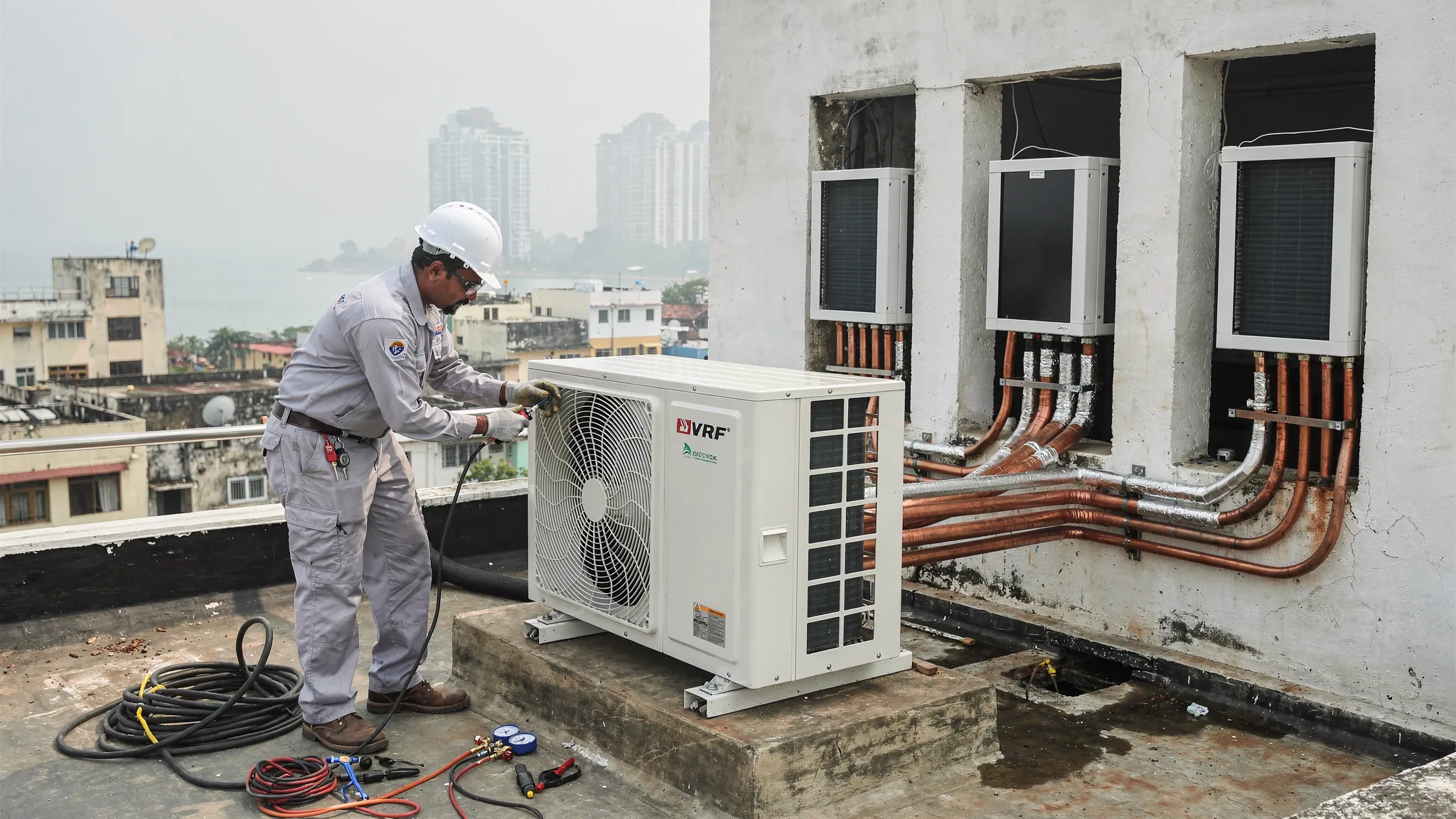
Budgeting the Total Cost of Ownership
- Upfront cost: Higher for 5-star inverter and VRF, lower for basic splits. Prices vary by brand and capacity.
- Energy cost: The largest lifetime cost component. For heavy users, a higher ISEER often pays back the premium in a few seasons.
- Maintenance: Plan on professional cleaning, coil maintenance and periodic checks for refrigerant leaks and drainage. An AMC can stabilize costs.
- Repairs and spares: Ask about PCB, sensor and fan motor costs outside warranty and whether genuine parts are stocked locally.
Choosing a Dealer that Matches the Expectations
At present, installation quality, local service and genuine spares are as important as model selection. Techno Power Aircons, the best AC Dealer in Chennai has been serving Chennai since 1982 across leading brands and formats, including inverter splits, cassette and ductable units and advanced VRF/VRV systems. You can also explore brand-specific guidance like best AC brands for Chennai heat. For upkeep, consider a predictable AC AMC plan.
Ask about current seasonal offers. Many buyers in Chennai also choose zero-cost EMI to spread payments and focus on higher-efficiency models that cut monthly bills.
The Bottom Line
- Go inverter-first, then optimize ISEER for your usage hours.
- Prioritize humidity control, filtration and corrosion protection for Chennai.
- Consider VRF if you need quiet, flexible multi-room comfort with fewer outdoor units.
- Budget for professional installation and an AMC to protect performance and warranty.
- Use a trusted AC Dealer for accurate sizing, brand comparisons and reliable after-sales support.
If you want help matching these current market trends to your home or office, speak with Techno Power Aircons. Contact us now for a right-sized recommendation, clean installation and dependable service throughout the life of your system.
Leave a Reply