

An AHU AC unit is equipment that moves cooled air through a building using fans, filters and ducts. It helps large indoor spaces stay comfortable by supplying clean, steady airflow to many rooms at once.
In modern commercial HVAC, an AHU AC unit is often paired with a central cooling source so the same system can serve multiple floors, departments or zones. In this article, we explain how an AHU AC unit fits into large-building design in Chennai, what to check before selecting one and the latest trends that improve comfort and energy efficiency. For expert guidance on selection, installation and service, many facilities work with Techno Power Aircons.

Why Large Buildings Rely on an AHU AC Unit
Large buildings have a different cooling challenge than homes. You need consistent airflow across long corridors, varying occupancy levels and multiple zones with different heat loads.
A well-designed AHU AC unit supports these needs by:
- Delivering uniform air distribution through duct networks
- Improving indoor air quality with multi-stage filtration
- Managing humidity better than many room-based systems
- Allowing centralised control for facilities teams
For a deeper explanation of the components and working principle, you can refer to What is AHU Unit.
How an AHU AC Unit Works in a Commercial HVAC System
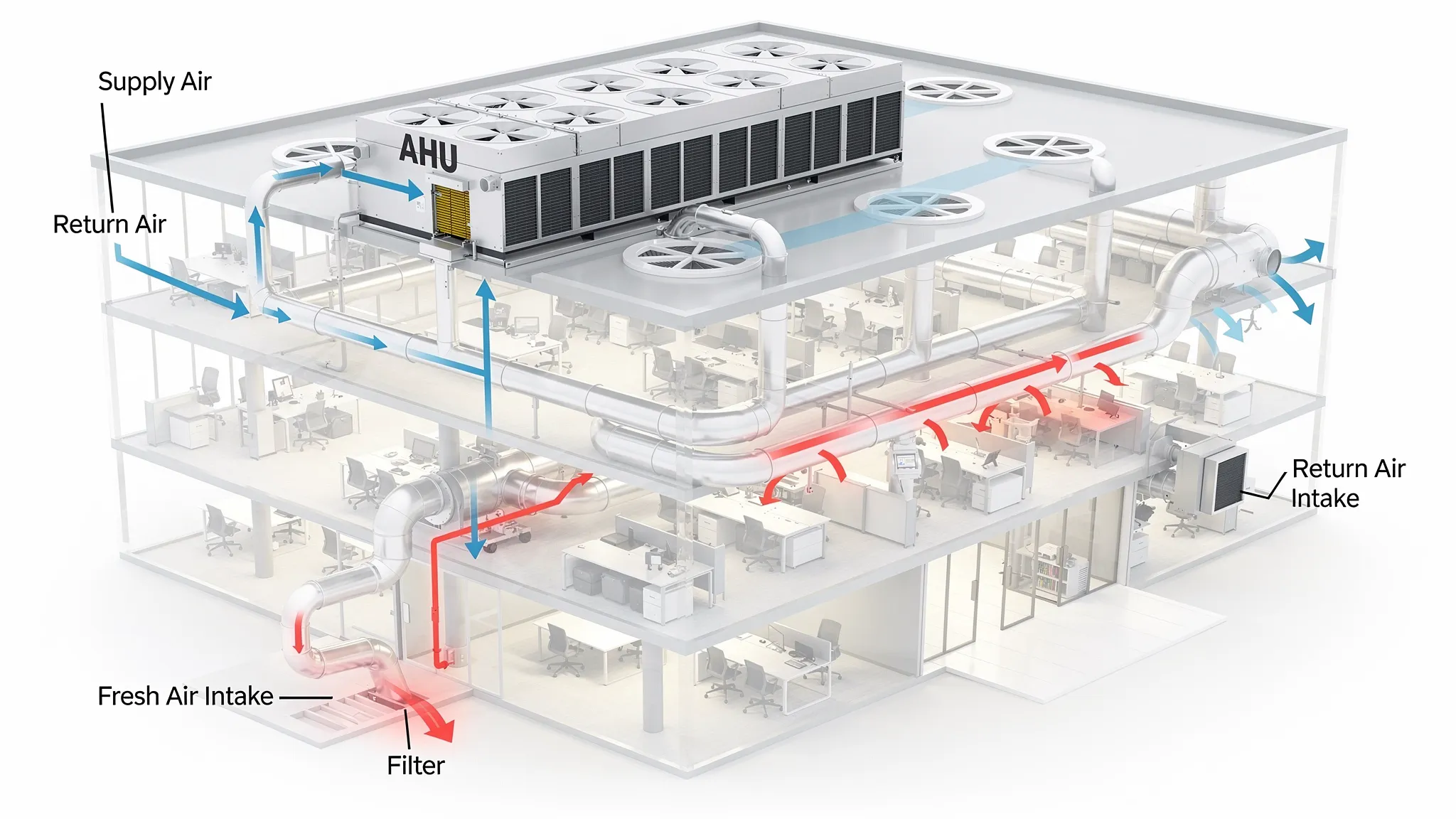
Think of the AHU AC unit as the “air mover and air cleaner” of the HVAC system. It draws return air from the building, mixes it with fresh air (as required), filters it and then pushes it through cooling coils so it reaches the required temperature. The fan section then distributes the conditioned air to different areas through ducts.
In many projects, the AHU AC unit is integrated with solutions such as VRF or VRV for zoning flexibility and operational efficiency. If you are comparing system options for a commercial site, see VRF, VRV, AHU Air Conditioners in Chennai.
Key parts you should understand
Even if you are not an HVAC engineer, knowing these sections helps you evaluate quotes and maintenance plans for an AHU AC unit:
- Filters (pre-filter and fine filter) to trap dust and improve indoor air quality
- Cooling coil to remove heat from the air
- Fan and motor section to maintain airflow across ducts
- Drain pan and drain line to manage condensate
- Controls and sensors for temperature, airflow and safety cut-offs
AHU AC Unit vs Other Indoor Cooling Formats
Large buildings may use multiple indoor formats in different zones. For example, a boardroom might need a different air throw pattern than an open office.
Here is a practical comparison that facilities managers often use during planning:
| Indoor cooling approach | Typical best-fit areas | Main advantage | Main limitation |
|---|---|---|---|
| AHU AC unit | Malls, hospitals, large offices, auditoriums | Centralised airflow, filtration and fresh air control | Needs ducts and space for plant room or service area |
| Cassette indoor units | Meeting rooms, retail zones, small offices | Good air distribution with neat ceiling look | Not ideal for long duct runs or high fresh-air needs |
| Ducted indoor units | Medium commercial spaces, restaurants, boutique offices | Hidden installation with flexible grilles | Requires duct planning and access for service |
| Portable air conditioning units | Temporary cabins, short-term spaces | Quick setup | Not suitable for whole-building cooling |
If you are considering ceiling-based options as part of a mixed solution, explore Cassette Air Conditioner and Ductable Air Conditioner.
Selection Checklist: How to Choose the Right AHU AC Unit for Your Building
Choosing the right AHU AC unit is not only about capacity. A slightly wrong design choice can increase energy bills, reduce comfort and add avoidable maintenance.
1) Match airflow and cooling to real usage
Large buildings in Chennai often see changing occupancy through the day. A good approach is to plan for realistic peak loads and then use smarter control strategies to reduce consumption during low-load hours.
Practical tip: Ask your HVAC partner whether the AHU unit can support variable fan speed operation and whether airflow can be balanced zone-wise during commissioning.
2) Prioritise filtration and indoor air quality
Indoor air quality expectations are rising across offices, hospitals and high-footfall retail. This is pushing more projects to upgrade filter grades and monitor filter pressure drop.
Practical tip: Choose a filtration setup that is easy to access. If filter access is ignored during design, the AHU AC unit tends to run longer with clogged filters which increases power consumption.
3) Plan maintenance access from day one
An AHU AC unit needs access panels for coil cleaning, filter replacement and drain inspection. If the unit is blocked by false ceilings or tight service corridors, service quality drops.
Practical tip: During layout finalisation, confirm service clearance and safe access paths for technicians.
Latest Trends in AHU AC Unit Design for 2026
Commercial HVAC buyers are focusing on long-term operating cost and healthier indoor environments. These trends are increasingly common in new projects and retrofits:
Smarter controls and monitoring
Facilities teams now prefer alerts for filter clogging, fan performance and abnormal temperature rise. When sensors and building management systems are configured correctly, an AHU unit becomes easier to run consistently without comfort complaints.
Energy-focused airflow strategies
Expect more emphasis on variable frequency drives, better airflow balancing and demand-based ventilation where suitable. This helps an AHU AC unit avoid wasting energy when zones are lightly occupied.
Better humidity control for coastal conditions
Chennai’s humidity makes comfort tricky. Many designers improve coil selection, drainage design and operating sequences so the AHU AC unit can control moisture without overcooling the space.
Maintenance Tips to Protect AHU AC Unit Performance
A commercial AHU AC unit is a long-term asset. With planned maintenance, it can deliver stable comfort for years while keeping energy use under control.
Here are simple steps that help most sites:
- Replace or clean filters on schedule based on dust load and usage
- Inspect drain pans and drain lines to prevent leaks and odour issues
- Check belt and bearing condition (where applicable) and verify fan vibration
- Clean coils periodically to maintain heat transfer
- Verify sensor readings during preventive service visits
Many building owners prefer structured service coverage so performance stays consistent across seasons. If you want a planned approach, consider AC AMC in Chennai for preventive maintenance support.
Use genuine parts for reliable repairs
When a site delays small repairs, the AHU unit can lose efficiency and create recurring comfort complaints. Using correct spares and replacing worn parts early often reduces total cost over time.
For sourcing support, you can refer to ac spare parts in Chennai.
Brand Options Commonly Specified in Large Projects
Large-building HVAC planning often involves a mix of manufacturers across outdoor units, indoor units and controls. In Chennai, buyers frequently evaluate brands like
-
O General – Known for robust performance and durability, often chosen for high-load commercial environments.
-
Mitsubishi Electric – Offers advanced VRF technology with precise control and strong energy efficiency.
-
Daikin – A global leader in VRV/VRF systems, widely specified for scalable and reliable commercial cooling.
-
Panasonic – Focuses on energy-efficient systems with intelligent control features for modern buildings.
-
Bluestar – An Indian brand with strong expertise in large central air conditioning and AHU applications.
-
Voltas – Well established in commercial HVAC projects, offering cost-effective and service-friendly solutions.
-
Carrier – Known for dependable central HVAC systems and integrated chilled water solutions.
-
Toshiba – Provides compact, efficient VRF systems suited for space-constrained commercial installations.
-
Haier – Expanding rapidly in commercial VRF systems with competitive pricing and modern controls.
-
Samsung – Delivers smart VRF solutions with advanced inverter technology and digital integration.
-
Hitachi – Trusted for high-efficiency VRF and chilled water systems in large infrastructure projects.
-
Hyundai – Offers commercial HVAC solutions designed for reliability and long-term operational stability.
For example, if your building design combines VRF or VRV zoning with central air movement, the AHU AC unit can be coordinated with outdoor systems based on project requirements and service strategy.
If you are exploring manufacturer-specific options for commercial deployments, Techno Power Aircons in Chennai supports multiple brands including Daikin AC and helps customers compare solutions based on capacity planning, installation feasibility and after-sales needs.
Conclusion
For malls, hospitals, offices and other high-occupancy spaces, an AHU AC unit remains one of the most practical ways to deliver consistent indoor cooling with strong airflow control and filtration. The right selection depends on airflow planning, filtration needs, humidity control and service access, not only on capacity. With smarter controls and energy-focused design trends growing in 2026, a modern AHU AC unit can also support better operating cost control and healthier indoor environments.
If you are planning a new project or upgrading an existing facility, Techno Power Aircons can help you choose and maintain the right AHU-based solution for your building. Contact us now to get expert solutions.
Frequently Asked Questions
What is an AHU AC unit used for?
An AHU unit is used to move and condition air for large spaces using ducts. It is common in commercial buildings where centralised airflow and filtration are important.
Is an AHU AC unit the same as a VRF indoor unit?
No. A VRF indoor unit directly cools a zone using refrigerant. An AHU unit primarily handles air movement and filtration and it can be paired with different cooling sources depending on system design.
How often should an AHU AC unit be serviced?
Service frequency depends on operating hours and dust load. Many commercial sites inspect filters monthly and schedule preventive maintenance quarterly or as recommended by the HVAC provider.
What are the most common AHU problems in large buildings?
Common issues include clogged filters, coil dirt buildup, drain blockages, airflow imbalance and sensor or control calibration errors.
Can an AHU AC unit improve indoor air quality?
Yes. With proper filtration and maintenance, an AHU AC unit can reduce dust and help manage ventilation which supports better indoor air quality for occupants.
Leave a Reply