
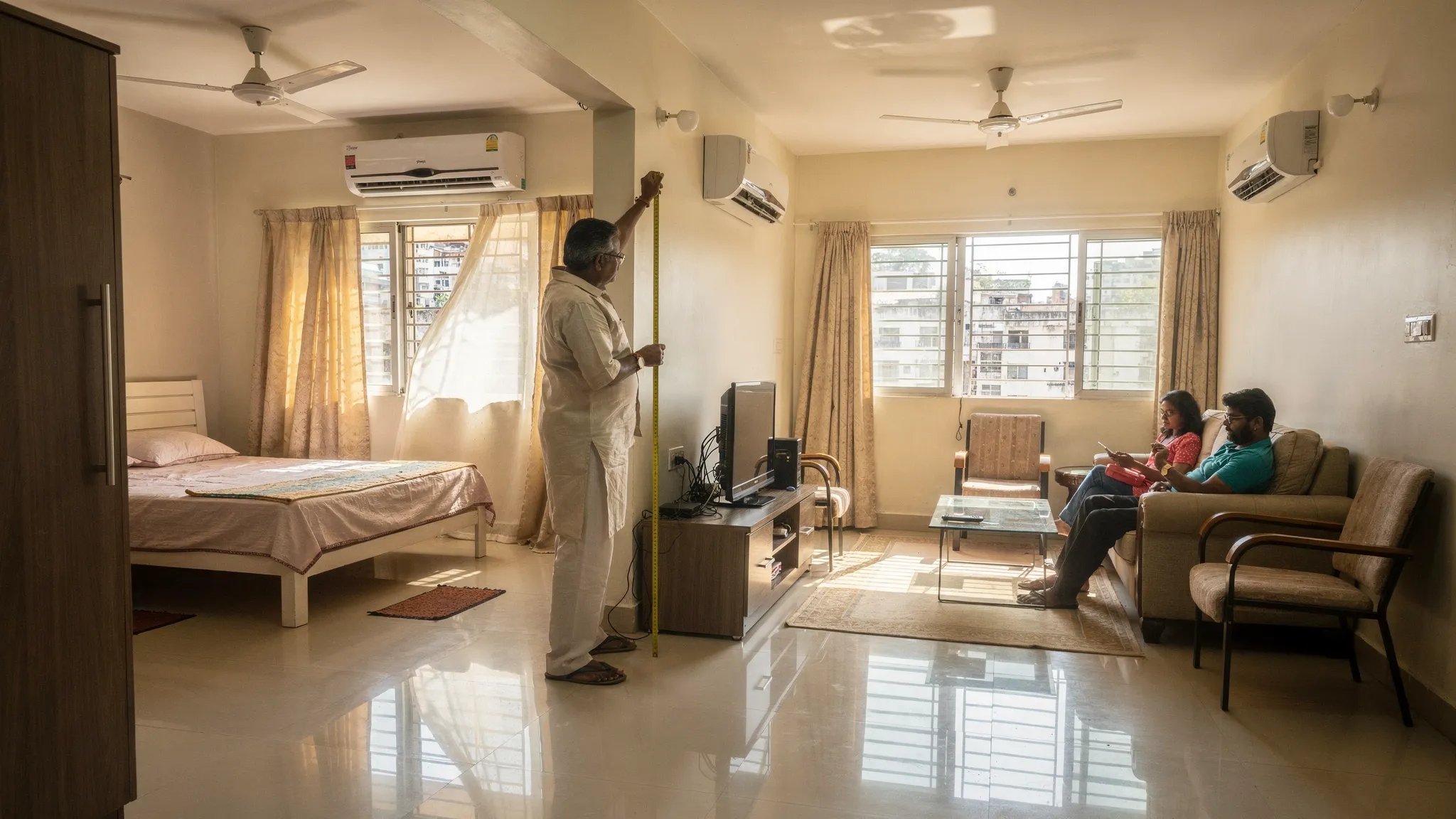
Buying an AC in Chennai usually starts with a simple question: Should I get a 1 ton or 1.5 ton AC unit? The right answer depends on your room size, heat load (sunlight, people, appliances), and even where your flat sits in the building.
Choose too small and the AC runs continuously but never feels comfortable. Choose too large and you may get quick cooling but poorer humidity control, more on-off cycling (in non-inverter models), and unnecessary upfront cost.
This guide breaks down 1 ton vs 1.5 ton in practical terms, with Chennai-specific factors so you can shortlist the right AC unit size before you compare brands and star ratings.
What “1 Ton” and “1.5 Ton” actually mean
In air conditioning, “ton” refers to cooling capacity, not weight.
- 1 ton (1 TR) is approximately 12,000 BTU/hour (about 3.5 kW) of cooling.
- 1.5 ton is approximately 18,000 BTU/hour (about 5.3 kW) of cooling.
In simple terms, a 1.5 ton AC can remove heat from a room faster and handle higher heat loads than a 1 ton.
Quick room size rule of thumb (good starting point)
For most Chennai homes with typical ceiling heights (around 8 to 10 feet) and average occupancy, the table below is a helpful starting point.
| Room size (approx.) | Typical recommendation | Notes |
|---|---|---|
| Up to 90 sq ft | 0.8 ton to 1 ton | Works best with good shading and fewer occupants |
| 90 to 120 sq ft | 1 ton | Most common “bedroom size” range |
| 120 to 180 sq ft | 1.5 ton | Better for halls/large bedrooms or higher sun exposure |
| 180 to 240 sq ft | 2 ton | Often needed for large living rooms |
Important: This is not a final sizing method. Chennai’s heat and humidity, plus your building layout, can push you up (or sometimes down) by one capacity step.
Chennai heat load factors that change the “right tonnage”
Two rooms with the same square footage can need different AC capacities. Here are the factors that matter most in Chennai.
1) Sun exposure and glass area
West-facing rooms and rooms with large windows heat up heavily in the afternoon. If your room gets strong direct sunlight, a 1 ton AC that looks perfect on paper can struggle.
2) Top-floor vs middle-floor apartments
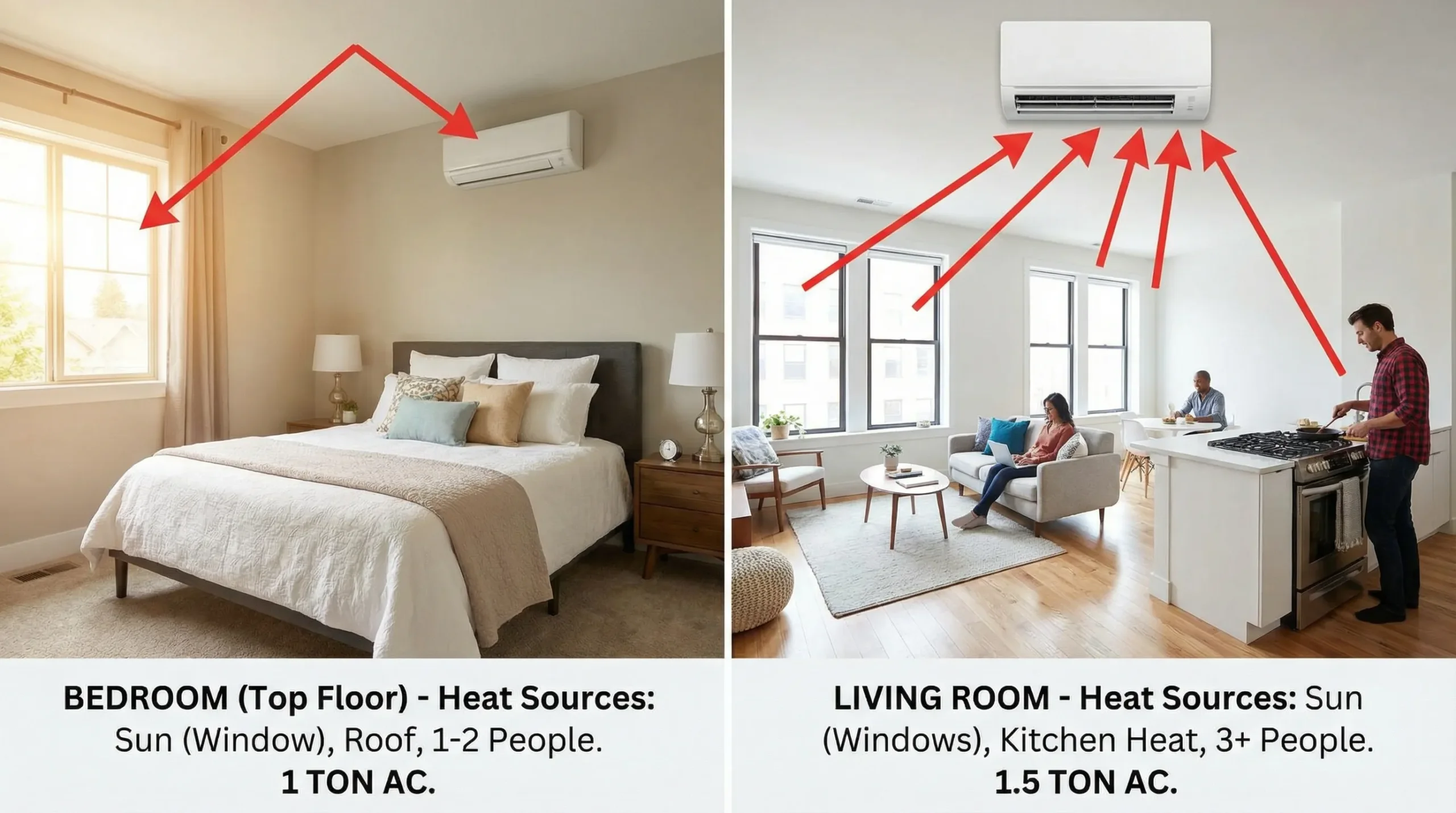
Top-floor rooms absorb heat from the roof slab. In peak summer, this can be the difference between “comfortable” and “AC running all day”.
3) Insulation, ventilation, and air leakage
Gaps under doors, leaky window frames, and poor sealing let hot, humid air keep entering. An undersized AC will never catch up.
4) Number of occupants
People add heat and moisture. A room used by one person at night is different from a living room with 4 to 6 people in the evening.
5) Appliances inside the room
TVs, gaming PCs, and even lighting add heat. If you work from home and run electronics for long hours, capacity matters more.
6) Ceiling height
If you have a higher ceiling than average, you are cooling more air volume, not just floor area.
1 ton vs 1.5 ton: which one fits your use case?
Below is a practical comparison based on what we see most often in Chennai homes.
When a 1 ton AC unit is usually the right choice
A 1 ton AC is generally a good fit when:
- Your room is roughly 90 to 120 sq ft
- It is a bedroom with 1 to 2 occupants
- The room has limited direct sun (or good curtains/shading)
- You mainly use the AC at night for sleeping
A correctly sized 1 ton inverter AC in a well-sealed bedroom can be very comfortable and cost-efficient.
When a 1.5 ton AC unit is usually the right choice
A 1.5 ton AC tends to make more sense when:
- The room is roughly 120 to 180 sq ft
- The space is a living room or hall with more footfall
- The room is west-facing, has large windows, or is on the top floor
- You want faster pull-down cooling (for example, you switch on the AC only when you return home)
For many Chennai apartments, a hall that is around 140 to 170 sq ft often performs better with 1.5 ton, especially if it faces the sun or connects to a dining area.
Why “bigger” is not always better
It is tempting to oversize “just to be safe”, but bigger capacity can create real comfort and efficiency problems.
Oversizing risks
- Humidity feels worse: When an AC cools too quickly and shuts off, it may not run long enough to remove moisture effectively.
- More cycling in non-inverter models: Frequent starts and stops can be noisier and may impact long-term wear.
- Higher upfront cost: Bigger units typically cost more, and may need sturdier mounting or electrical changes.
Undersizing risks
- AC runs continuously and still feels warm
- Higher electricity usage in practice because the unit operates at full load for long hours
- Uneven cooling and discomfort during peak afternoon heat
The goal is: right-sized capacity + high efficiency + good installation.
Does inverter technology change sizing? A little, but not completely
Inverter ACs can vary compressor speed and match cooling output to the room’s needs. This helps in two ways:
- They reduce frequent on-off cycling.
- They can maintain a stable temperature more efficiently.
However, inverter does not magically fix wrong tonnage. A very undersized inverter AC can still struggle in Chennai’s peak heat, and an oversized inverter AC can still reduce run-time enough to affect dehumidification in some situations.
Practical takeaway: Choose the right tonnage first, then choose inverter and star rating to optimise running cost.
A simple “upsizing” checklist for Chennai homes
If you match the 1 ton room-size range but have one or more of the factors below, consider 1.5 ton (or get a professional assessment):
- Strong direct sun for several hours (especially west-facing)
- Top-floor room with roof heat
- Large window area or poor shading
- 3 or more occupants in the room often
- Connected spaces (hall + dining) that behave like a larger area
- Frequent door opening (for example, near kitchen or corridor)
Compare 1 ton vs 1.5 ton at a glance
| Factor | 1 ton AC unit | 1.5 ton AC unit |
|---|---|---|
| Best for | Small to mid bedrooms | Larger bedrooms, halls, higher heat-load rooms |
| Cooling speed | Moderate | Faster |
| Handles peak heat load | Limited if sun/top-floor | Better buffer for harsh conditions |
| Risk if chosen incorrectly | Struggles to cool, runs nonstop | Higher cost, potential humidity/cycling issues |
| Typical buyer profile | Night-time bedroom users | Evening living room use, sun-exposed rooms |
Don’t ignore energy labels: tonnage decides comfort, efficiency decides bills
Two ACs of the same tonnage can have different running costs depending on efficiency.
In India, efficiency is commonly communicated through BEE star ratings and metrics like ISEER for inverter ACs. For background, you can refer to the Bureau of Energy Efficiency (BEE) resources.
Practical buying tip: After you shortlist capacity (1 ton or 1.5 ton), compare:
- Star rating/efficiency (especially if usage is daily)
- Inverter vs non-inverter based on your usage hours
- Warranty terms and service network
Signs you picked the wrong AC unit size
These symptoms can help you decide whether you need a capacity correction (or if maintenance/installation is the real issue).
Signs the AC is undersized
- Room never reaches the set temperature during afternoon peak
- Unit runs constantly at high fan speed
- Temperature near the bed/sofa feels different from the rest of the room
Signs the AC is oversized
- Room cools quickly but feels clammy
- Non-inverter unit switches on and off frequently
- You feel cold spots near the indoor unit while other corners feel less comfortable
Note: Similar symptoms can also come from improper installation, gas leakage, dirty filters/coils, or wrong placement of the indoor unit.
Installation quality matters as much as tonnage
Even a perfectly sized AC can perform poorly if installation is not done correctly. Common real-world issues include:
- Indoor unit placed where airflow does not reach the room evenly
- Refrigerant piping length/bends not as per manufacturer recommendations
- Poor drainage slope leading to water leakage
- Outdoor unit kept in a hot, poorly ventilated corner
If you are buying a new system, it helps to work with an experienced dealer who can recommend tonnage and also handle installation and after-sales support.
Need help choosing between 1 ton and 1.5 ton in Chennai?
If you are still deciding, a quick site evaluation (room measurements, sun direction, occupancy, usage pattern) usually makes the answer clear.
Techno Power Aircons has been an AC dealer in Chennai since 1982, supporting sales, installation, and after-sales service across leading brands, including solutions ranging from residential split ACs to VRF/VRV systems for larger spaces.
- For home installations, explore Split AC options and support in Chennai.
- If you want to keep performance steady year after year, consider periodic maintenance or AC AMC in Chennai.
- For larger homes, offices, or multi-zone needs, you can also learn the basics of VRF/VRV systems.
If you share your room size, floor level, and sun-facing direction, our team can guide you to the most suitable AC unit size (1 ton vs 1.5 ton) and the right type for your space.

Leave a Reply